NBS says inflation slows to 21.88% but Nigerians ask: ‘Na statistics we go chop?’

The National Bureau of Statistics (NBS) has announced that Nigeria’s inflation rate eased slightly in July 2025, dropping to 21.88 percent from 22.22 percent recorded in June. On paper, this looks like good news and a sign that government efforts to stabilize the economy may be taking hold. Yet for millions of Nigerians living through rising food costs, shrinking purchasing power, and a daily struggle to make ends meet, the announcement has been met with skepticism, frustration, and even anger.
The report released on Friday, August 15, shows that inflation is not only easing compared to the previous month but also looks better when placed side by side with last year’s figures. On a year-on-year basis, the headline inflation rate was 11.52 percent lower than July 2024 when inflation stood at a staggering 33.40 percent. On the surface, this seems like progress. However, the lived reality on the streets tells a more complicated story.
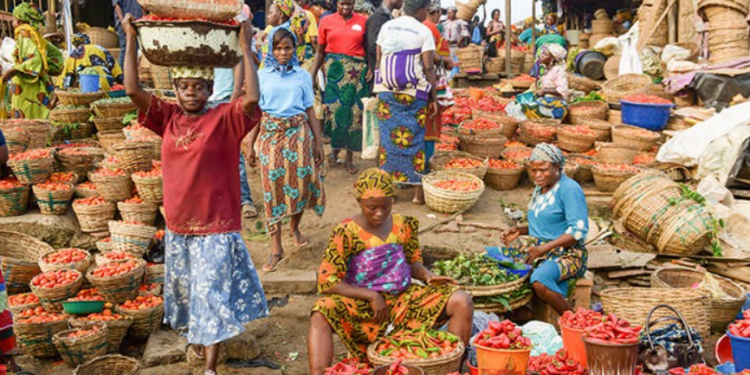
For most Nigerians, these percentages and charts hardly mean anything when a bag of rice has more than doubled in price in less than two years, when bread is almost becoming a luxury, and when salaries cannot keep pace with the cost of basic survival. The frustration is so deep that many citizens have taken to social media to question the relevance of such figures.
On X (formerly Twitter), the reactions poured in almost immediately after the report was published. One user with the handle I Believe (@ainamo94) noted that financial requests from friends and family have been increasing daily, a clear sign that more Nigerians are sinking into poverty. “And you are telling me inflation is easing? These figures are not a true reflection of reality,” he wrote.
Another user, Burgerman (@snezcoman), was blunt. “Nobody trusts whatever numbers you throw out,” he declared. The sentiment of mistrust ran through most of the reactions, with many accusing the government of massaging figures to make the economic situation look better than it truly is.
One particularly biting comment came from Nnachi (@Godswillluv), who accused the NBS of fabricating statistics to favor President Bola Tinubu’s administration. “We are in the streets, inflation is still as high as when this catastrophic presidency came to power and removed fuel subsidy without proper planning,” he wrote.
The anger did not stop there. Another user, EDO NATION (@CHRISOBOH666), said people cannot even feed, yet officials continue to publish figures that suggest otherwise. Darth tenebrous (@anyabebop) dismissed the report outright, calling NBS and the Central Bank “a bunch of illiterates” who are cursed with poor management.
Some Nigerians also raised technical questions about the methodology. AKS WatchDog (@AksWatchdog) argued that changing the base year for inflation calculations was a tactic to artificially lower the numbers. According to him, if the old base year of 2009 had been maintained, inflation could be closer to 30 percent rather than 21.88.
Even when the figures show progress, many feel the improvements are too abstract to matter. Victor Azubuike (@v_ogbunugafor) captured this when he said, “The average Nigerian does not understand these figures. Purchasing power has decreased to the barest minimum due to the high cost of goods and services. That is the reality on the ground. As President Tinubu himself once asked: ‘na statistics we go chop?’”
Yet not every reaction was negative. Some Nigerians tried to take a more hopeful view of the report. Akereyejo (@Palermo_seun) expressed optimism, saying the country is on the right path and that eventually the effects will be felt. Another user, Osas (@osazenoo), pointed out that inflation had been 24.48 percent in January 2025 and had now fallen to 21.88 percent by July. He argued that while the target of 15 percent may not be reached soon, the gradual decline should be seen as a positive trend.
Economists have also weighed in on the debate. Dr. Ango Malari of the Society for Peacebuilding and Economic Advancement acknowledged that inflation may be decelerating but stressed that food inflation at 22.74 percent remains a huge problem. According to him, many staple foods have become luxuries, and this is where Nigerians feel the pinch most. Similarly, another analyst, Sam Maiyaki, explained that while government measures may be bringing inflation down on paper, the real question is whether this translates into better living standards. His conclusion was blunt: “I am yet to see that. People are still suffering.”
The presidency, on the other hand, welcomed the report with enthusiasm. Sunday Dare, the Special Adviser to the President on Media and Public Communication, described the trend as inspiring. He reminded Nigerians that President Tinubu had promised to bring inflation closer to 15 percent and argued that the current trajectory shows progress. Bayo Onanuga, another presidential spokesperson, echoed the same sentiment, describing the NBS report as “good news” and accusing opposition figures of refusing to acknowledge positive developments.
Behind the numbers, the details of the July report reveal a nuanced picture. While the headline inflation slowed, the month-on-month inflation rate actually rose slightly from 1.68 percent in June to 1.99 percent in July. This means that although the pace of inflation is easing year-on-year, prices are still climbing month-to-month, and Nigerians continue to feel the squeeze.
Food inflation remains particularly worrying at 22.74 percent. This is significant because food accounts for a large share of household spending in Nigeria. When food prices rise, it hits the poorest the hardest and widens inequality. This explains why, despite official statistics pointing to progress, the lived experience for many families is still one of hardship.
The big question, then, is how much weight should Nigerians give to official statistics when their daily lives tell a different story. Inflation, after all, is not just an economic indicator but a reflection of how much people can actually buy with their money. For those who skip meals, cut back on protein, or borrow just to survive, reports of easing inflation sound hollow, if not insulting.
In the end, the gap between official data and public perception highlights a deeper challenge in Nigeria’s economy: trust. Until statistics translate into cheaper food in the market, more affordable transport, and better living standards, many Nigerians will continue to ask that haunting question, “Na statistics we go chop.


Responses