“They Put Their Lives on the Line”: Tinubu Praises Nigerian Military, Urges National Support

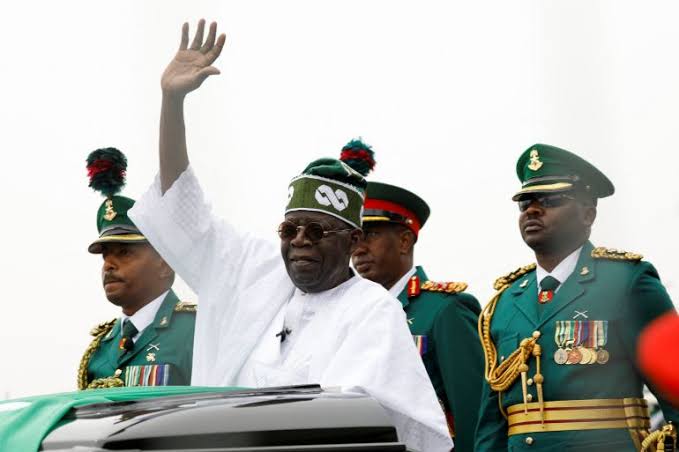
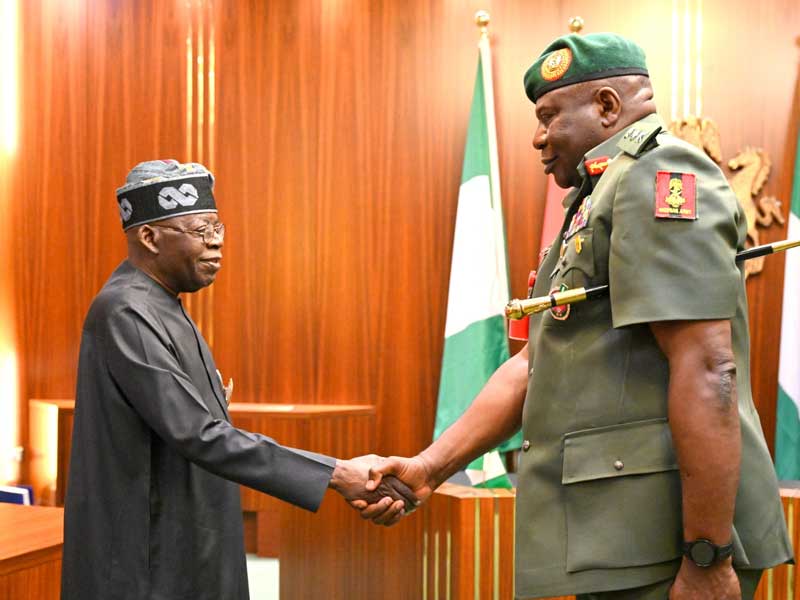
President Bola Ahmed Tinubu has commended the bravery and sacrifice of the Nigerian Armed Forces, describing the military as the backbone of the country’s sovereignty and unity. Speaking on Wednesday at the Nigerian Guild of Editors (NGE) Conference in Abuja, Tinubu said the men and women of the military deserve the respect, encouragement, and gratitude of every Nigerian citizen.
The President’s remarks, though framed around national security and patriotism, have sparked widespread discussion, with many interpreting his comments as a subtle but pointed message amid the ongoing controversy surrounding Minister of the Federal Capital Territory (FCT), Nyesom Wike, and his recent confrontation with a military officer in Abuja.
Tinubu began his address by acknowledging Nigeria’s ongoing security challenges — including terrorism, banditry, and insurgency — but emphasized that the focus should not only be on the threats but also on those who risk everything to contain them.
“Yes, we are challenged by terrorism, banditry, and others. We recognise that,” he said.
“Are we doing something about it? Are we inspiring the armed forces? Are we encouraging them to fight? They put their lives on the line to defend the sovereignty of this country. It is our responsibility.”
The President’s tone was firm yet empathetic — a reminder of the sacrifices made daily by soldiers stationed in volatile regions. He underscored that maintaining morale among troops was vital to the success of national defense and stability, urging both citizens and political leaders to show restraint and respect when dealing with uniformed personnel.
Tinubu’s remarks were widely covered by local and international media, including Channels Television, which headlined the story: “They Put Their Lives on the Line — Tinubu Hails Nigerian Military.”
Public Reaction and Political Undercurrents
Online discussions, particularly on Nairaland, quickly turned the President’s statement into a trending topic. Many Nigerians praised the President’s tone as presidential and diplomatic, seeing it as an indirect rebuke of the recent viral incident involving Minister Wike and a military officer on duty in Abuja.
One user commented, “Tinubu spoke exactly the way a reasonable President should. Wike is not the only minister in Nigeria. He cannot treat military men like civilians from Rivers State.”
Another remarked, “Wike will be disappointed and pained after seeing this statement. Tinubu is simply distancing himself from his minister’s excesses.”
Some commenters also suggested that the President’s statement was a strategic move — a subtle attempt to calm rising military discontent and reaffirm his control as Commander-in-Chief amid growing public outrage over the Wike incident. “A commander must raise the morale of his army,” one user wrote. “Wike, na on your own you dey ooo.”
Others, however, defended Wike, insisting he was only enforcing order in the FCT and that his altercation had been overblown by the media. “Wike is simply doing his job. God bless Wike, God bless the Nigerian Army, God bless the President,” one post read, reflecting the split in public sentiment.
Still, a larger section of commentators viewed Tinubu’s message as both timely and tactical, given the fragile balance between civilian authority and military confidence in a country with a history of coups. One user joked, “Baba dey fear coup — maybe na now day break for where BAT dey,” while another warned, “Challenging the military na bad idea. Them fit change am for you.”
Beyond the Headlines
Political analysts note that Tinubu’s approach demonstrates his understanding of Nigeria’s delicate civil-military relationship. Unlike his fiery FCT Minister, the President’s language leaned toward conciliation and institution-building, not confrontation. The emphasis on “inspiring and encouraging the armed forces” was seen as an effort to steady the chain of command and project reassurance to the security establishment.
The President’s remarks also reignited debates about leadership style and public communication within his administration. While some observers credit Wike for his hands-on governance in Abuja, others argue that his combative style risks overshadowing the President’s broader reform agenda.
For many Nigerians, Tinubu’s message served as a reminder that the military remains one of the few national institutions that still command respect and unity across ethnic and political lines. “Taking up that job is probably the most patriotic,” a commenter wrote, “except if we want to deceive ourselves.”
In the end, the President’s tribute to the armed forces resonated far beyond the conference hall — as both a statement of gratitude and a gentle warning that national discipline, respect, and order must be upheld, no matter one’s political stature.



Responses