President Tinubu Urges Responsible Journalism at Editors’ Conference, Calls for Unity in National Discourse

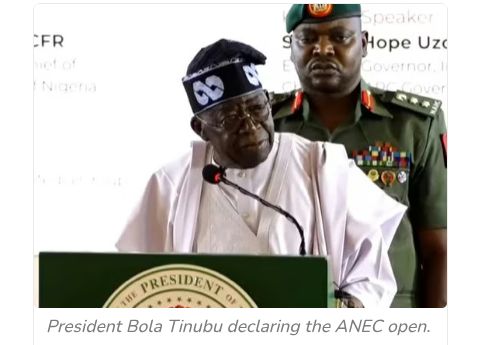
President Bola Ahmed Tinubu has called on Nigerian editors and media professionals to uphold the principles of truth, integrity, and responsibility in their work, emphasizing that the press plays a crucial role in sustaining democracy and promoting national cohesion. The President made the appeal during his opening address at the 2025 Annual Conference of the Nigerian Guild of Editors (NGE), held at the State House in Abuja on Wednesday, November 12.
In his speech, titled “Democratic Governance and National Cohesion: The Role of Editors,” Tinubu described journalism as a cornerstone of Nigeria’s democratic development and an enduring instrument of national awakening. He commended the resilience of Nigerian journalists who, over the decades, stood firm in defense of truth and justice — from the struggle against colonialism to the fight against military dictatorship. According to him, “Throughout our history, journalism in Nigeria has been more than a profession. It has been an instrument of national awakening.”
President Tinubu paid tribute to journalists who suffered persecution, detention, and hardship in their pursuit of justice, describing their sacrifices as part of the foundation on which Nigeria’s democracy stands. However, he reminded the media that freedom is not self-sustaining and requires responsibility. “A democracy is sustained not only by elections and laws, but also by the integrity of public conversation,” he stated.
He urged editors to use their influence responsibly, stressing that their editorial choices shape public opinion and national direction. “You shape narratives. You influence public understanding. You decide what becomes national focus and how our collective challenges are interpreted,” the President said, adding that the responsibility must be exercised with wisdom, fairness, and patriotism.
Tinubu also addressed the growing challenge of misinformation and the impact of social media on the media landscape. He noted that in an age where every citizen can act as a publisher, falsehoods can spread faster than the truth, often fueling mistrust and division. He called for a renewed commitment to fact-checking, balance, and professional judgment in journalism, emphasizing that “verification must be your anchor; balance must be your principle and professional judgement must be your guide.”
While defending the right of the media to criticize government policies, the President appealed for constructive engagement, urging editors to critique “with knowledge and fairness” rather than resort to cynicism or sensationalism. “Your aim must never be to tear down, but to help build a better society,” he said.
On national issues, Tinubu reaffirmed his administration’s commitment to securing the country, stabilizing the economy, and expanding opportunities for citizens. He acknowledged the challenges posed by ongoing reforms but maintained that the difficult decisions being made are designed to build a stronger economic foundation. “We have taken steps to restore macroeconomic balance, encourage investment and rebuild confidence,” he noted, while admitting that much work remains to be done to ensure that economic growth translates into tangible improvements in the lives of Nigerians.
The President emphasized that governance alone cannot build the Nigeria of everyone’s dreams, saying that nation-building requires trust, cooperation, and shared responsibility among government, private sector, civil society, and the media. “Let us choose clarity over confusion, responsibility over recklessness, and hope over despair,” he said in closing.
The speech drew mixed reactions across the country and on social media. Supporters hailed it as a thoughtful and inspiring address, commending Tinubu for recognizing the importance of responsible journalism in democracy. “Nice speech from His Excellency,” one commentator wrote, while others praised his call for integrity and professionalism in the media.
Critics, however, argued that the President’s remarks failed to address pressing national issues such as insecurity and ongoing industrial strikes. Some pointed out that while Tinubu spoke about truth and unity, Nigerians were still struggling with economic hardship and a sense of disconnection from government policy. “This man hardly speaks about terrorism or the doctors’ strike,” one critic said, adding that “he talks as if all is well.”
Others countered that such criticisms underscored exactly what the President was warning against—irresponsible commentary and politically motivated narratives that distort facts. “Irresponsible media and irresponsible opposition won’t win elections,” another commenter argued.
Despite the divergent opinions, Tinubu’s speech has reignited debate about the state of journalism in Nigeria and its evolving role in an era of digital disruption and political polarization. Many observers agree that his message reflects an urgent call for ethical responsibility, national unity, and balanced reportage — values that remain essential for sustaining Nigeria’s democracy in challenging times.




Responses