Muhammad Ali’s Historic Night Out in Lagos: A Glimpse into Nigeria’s Cultural Past, August 1964

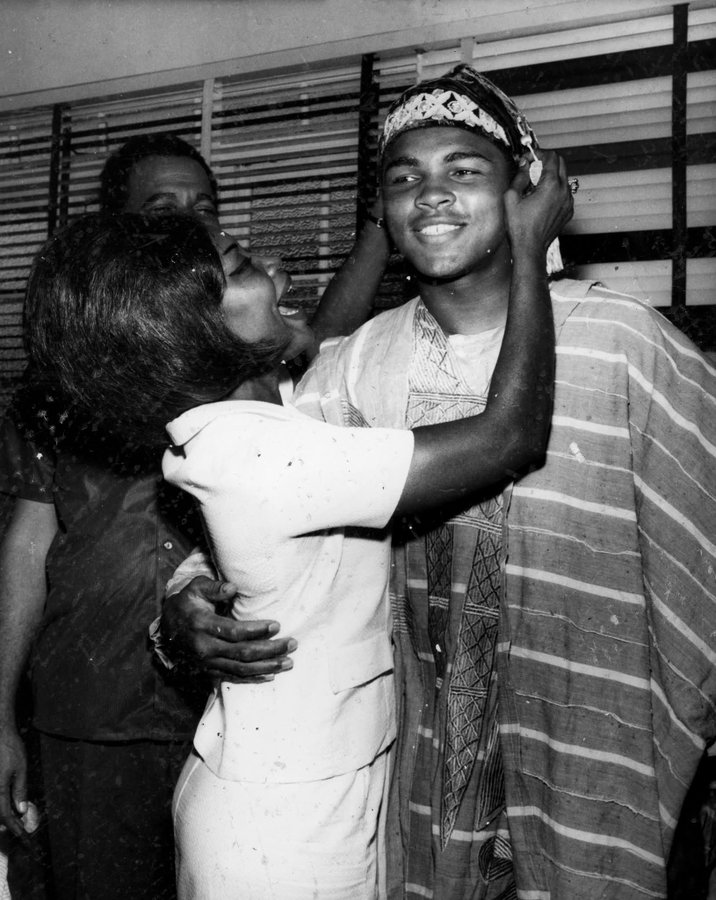
In August 1964, Lagos played host to one of the most iconic figures in global sports history when legendary boxer Muhammad Ali, then newly crowned world heavyweight champion, visited Nigeria. A rare photograph capturing Ali at a nightclub in Yaba, Lagos, has recently resurfaced online, sparking nostalgia, admiration, and renewed conversations about Nigeria’s place in global history and the cultural exchanges of the 1960s.
At the time of the visit, Muhammad Ali had only months earlier defeated Sonny Liston to win the heavyweight boxing title, an achievement that shocked the sporting world and announced his arrival as a dominant force in boxing. Still in the early years of his fame, Ali embarked on tours that took him beyond the United States, connecting with Africa and the African diaspora at a time when issues of identity, race, colonialism, and civil rights were at the forefront of global discourse.
His presence in Lagos in 1964 was significant. Nigeria had gained independence just four years earlier, and Lagos was a vibrant cultural and political hub, attracting global attention as a symbol of Africa’s post-colonial promise. Ali’s visit coincided with this era of optimism and self-discovery, making his appearance more than just a celebrity stopover—it was a powerful moment of cultural affirmation.
The now-viral image shows Ali relaxed and stylish, dressed in traditional Nigerian attire as he enjoyed a night out in Yaba, one of Lagos’ oldest and most intellectually active districts. Yaba, known for its educational institutions and lively social scene even in the 1960s, provided the perfect backdrop for a meeting of worlds: a global sports icon immersing himself in local nightlife and culture.
Observers have noted how the photograph reflects the elegance and modesty of nightlife fashion at the time. The women in attendance were dressed with poise and sophistication, challenging modern assumptions about nightlife culture and reinforcing the idea that social spaces once balanced glamour with restraint. For many Nigerians, the image is a reminder of an era when style, dignity, and social interaction followed a different rhythm.
Beyond fashion and nostalgia, Ali’s visit carried deeper symbolism. Having recently changed his name from Cassius Marcellus Clay Jr. to Muhammad Ali after joining the Nation of Islam, he had openly rejected what he described as a “slave name,” choosing instead an identity that aligned with his religious and political awakening. His presence in Nigeria—Africa’s most populous Black nation—reinforced his growing connection to the continent and its people.
Accounts from historians and commentators suggest that during this visit, Ali was warmly received by Nigerians and may even have been given a Yoruba name, reportedly “Omowale” or “Adewale,” symbolizing a sense of homecoming and shared heritage. He is also said to have visited Ibadan, where crowds reportedly turned out in large numbers to welcome him. These moments highlighted the emotional bond many African-Americans felt when reconnecting with Africa, a sentiment that would later influence movements such as Pan-Africanism and Black consciousness globally.
Muhammad Ali’s refusal to fight in the Vietnam War a few years later would further cement his legacy as more than an athlete. He became a symbol of resistance, conviction, and moral courage, admired by millions worldwide and criticized by others who questioned his patriotism. In retrospect, his Lagos visit appears as an early chapter in his broader journey as a global icon who consistently aligned himself with struggles for dignity and self-definition.
The resurfacing of this photograph has reignited debates online about identity, colonial legacies, and cultural pride. While opinions differ on the symbolism of names, clothing, and religion, there is broad agreement on one point: Muhammad Ali’s visit to Lagos in 1964 remains a historic and inspiring moment.
More than six decades later, the image stands as a visual bridge between generations, reminding Nigerians that the country has long been part of global cultural history. It also reinforces Ali’s enduring legacy—not just as “The Greatest” boxer of all time, but as a figure who transcended sport to become a symbol of Black excellence, global solidarity, and cultural pride.



Responses