ADC Raises Alarm Over Alleged Plot Ahead of 2027 Elections

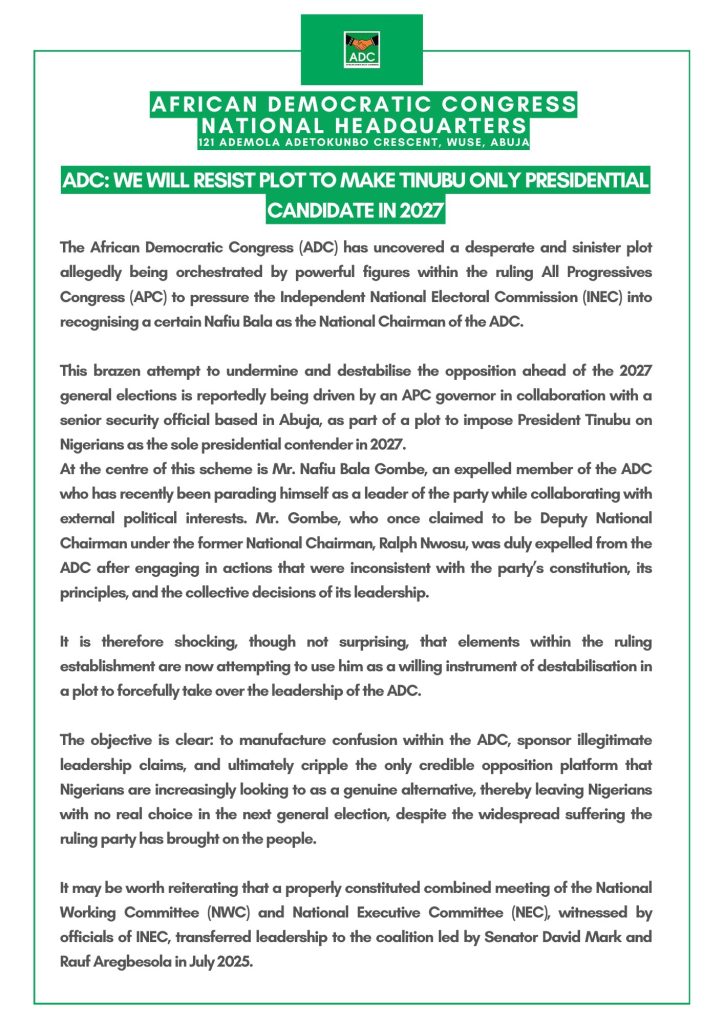
The African Democratic Congress (ADC) has sparked fresh political debate after alleging a plot by powerful figures within the ruling All Progressives Congress (APC) to weaken opposition parties ahead of the 2027 general elections.
According to the party, there are moves to pressure the Independent National Electoral Commission (INEC) into recognising a disputed leadership figure within the ADC. The party claims this is part of a broader strategy aimed at destabilising opposition structures and ultimately paving the way for President Bola Ahmed Tinubu to face little or no serious competition in the next presidential election.
While the allegation has not been independently verified, it has triggered strong reactions across the political space, with many Nigerians divided over its credibility and implications.
Concerns Over One-Party Dominance
At the heart of the ADC’s claim is a fear shared by some political observers—that Nigeria could drift toward a de facto one-party system if opposition parties continue to weaken internally while the ruling party consolidates power.
Supporters of the ADC’s position argue that political interference in party leadership disputes, if true, would represent a dangerous precedent. They believe that democracy thrives on competition, and any attempt—real or perceived—to sideline opposition voices could undermine the integrity of the electoral process.
For such critics, even the suggestion that a sitting government might influence internal party affairs raises red flags about the independence of institutions and the fairness of future elections.
Skepticism and Criticism
However, not everyone is convinced by the ADC’s claims.
Some critics argue that the party is deflecting attention from its own internal challenges, including leadership disputes and lack of a clear political direction. They maintain that opposition parties in Nigeria often struggle more from internal divisions than from external interference.
Others point out that it would be practically impossible for any president, including Tinubu, to run unopposed in a country with multiple registered political parties and a vibrant—if sometimes fragmented—political landscape.
From this perspective, the real issue is not a grand conspiracy but the inability of opposition parties to unite, build strong grassroots support, and present a compelling alternative to voters.
The Bigger Political Picture
Nigeria’s political environment has long been characterised by shifting alliances, defections, and internal party crises. In recent years, both major and smaller parties have experienced factional disputes that have weakened their structures.
This has led to calls for stronger internal democracy within parties, as well as reforms to ensure that institutions like INEC remain neutral arbiters in electoral matters.
The mention of a “sole candidate” scenario, while seen by many as unrealistic, touches on deeper anxieties about electoral fairness, judicial independence, and the use of state power in political contests.
Looking Ahead to 2027
With the 2027 elections still some distance away, political maneuvering is already intensifying across party lines. Analysts say the outcome will likely depend less on allegations and more on how effectively parties organise themselves, resolve internal conflicts, and connect with voters.
For the ADC and other opposition groups, the challenge will be to move beyond rhetoric and present a clear vision that resonates with Nigerians. For the ruling APC, maintaining public trust and ensuring transparent governance will be equally critical.
Ultimately, Nigeria’s democracy will be tested not just by political accusations, but by the strength of its institutions and the ability of its leaders—across all parties—to uphold democratic principles.


Responses