Tinubu Hosts Governors in Lagos, Vows Stronger Action on Insecurity

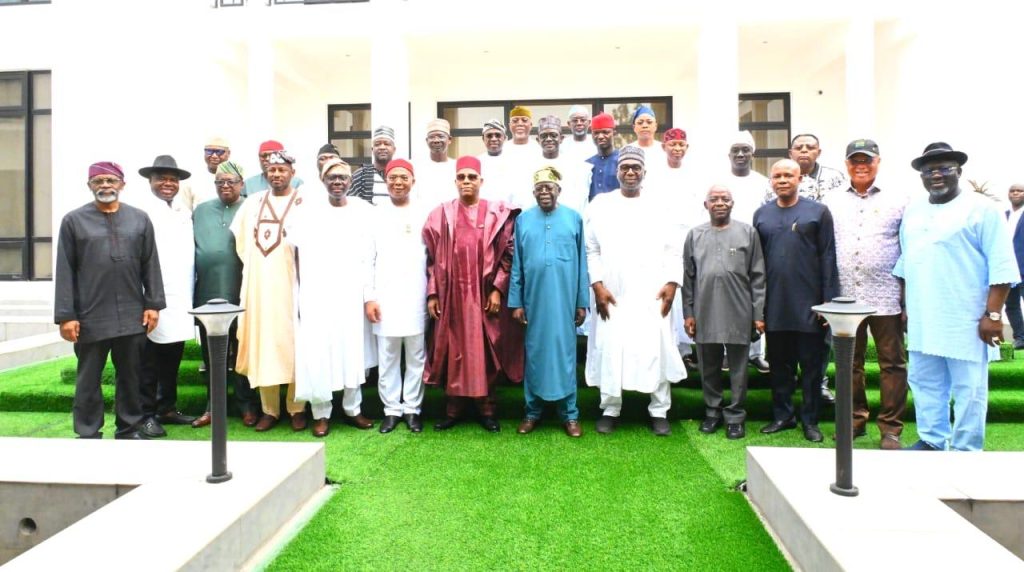
President Bola Ahmed Tinubu on Sunday received a large delegation of state governors at his residence in Lagos, where he used the occasion to reaffirm his administration’s commitment to tackling insecurity and supporting vulnerable Nigerians.
The meeting, which took place during the Eid-el-Fitr celebrations, brought together Vice President Kashim Shettima and over 20 governors from across the country. The gathering was both symbolic and strategic, reflecting ongoing consultations between the federal government and state leaders on pressing national issues.
Addressing the governors, President Tinubu emphasized that insecurity remains one of the biggest threats to Nigeria’s development, prosperity, and unity. He assured them that his administration is intensifying efforts to address the challenge through both domestic strategies and international partnerships.
According to the President, discussions held during his recent visit to the United Kingdom included key security concerns, particularly around acquiring modern equipment and strengthening operational capacity. He also revealed that he had further engagements with Emmanuel Macron to secure additional support for Nigeria’s security architecture.
Tinubu stressed that collaboration among all levels of government is essential in overcoming the country’s security challenges. He urged governors to remain proactive and committed to implementing policies that directly impact citizens, while also supporting federal initiatives aimed at combating criminal activities nationwide.
Beyond security, the President highlighted the economic implications of global events, particularly tensions in the Middle East. He warned that the crisis could drive inflation higher, affecting energy prices and the cost of living. As a result, he called on governors to introduce measures that would cushion the impact on ordinary Nigerians, especially the most vulnerable.
The Chairman of the Nigeria Governors Forum and Governor of Kwara State, AbdulRahman AbdulRazaq, speaking on behalf of his colleagues, commended the President for his leadership and recent international engagements. He noted that the state visit to the UK—the first of its kind in decades—signals a renewed diplomatic relationship that could benefit Nigeria in terms of investment and cooperation.
AbdulRazaq also touched on the ongoing discussions around state policing, revealing that the governors’ forum is working with security agencies to develop a framework that could eventually be presented to the National Assembly. The issue of state police has long been debated in Nigeria, with many arguing that decentralizing security could improve response times and effectiveness.
The governors present at the meeting cut across party lines, including leaders from both ruling and opposition parties. This broad representation underscores the importance of the issues discussed and suggests a level of consensus on the need to address insecurity and economic pressures.
However, public reactions to the meeting have been mixed. While some view the gathering as a sign of unity and coordinated governance, others remain skeptical, arguing that such meetings often yield limited tangible results. Critics point to ongoing insecurity and economic hardship as evidence that more concrete action is needed beyond high-level consultations.
There are also political undertones to the meeting. The presence of numerous governors alongside the President has fueled speculation about shifting political alliances ahead of the 2027 elections. In Nigeria’s political landscape, such gatherings often serve dual purposes—governance and strategic positioning.
Despite differing opinions, the Lagos meeting highlights a critical reality: Nigeria’s challenges require cooperation across federal and state levels. Whether this renewed engagement will translate into measurable improvements in security and economic conditions remains to be seen.
For now, the administration appears focused on building partnerships—both local and international—as it seeks to navigate the complex issues facing the nation.


Responses