Kinloch Castle Back on the Market

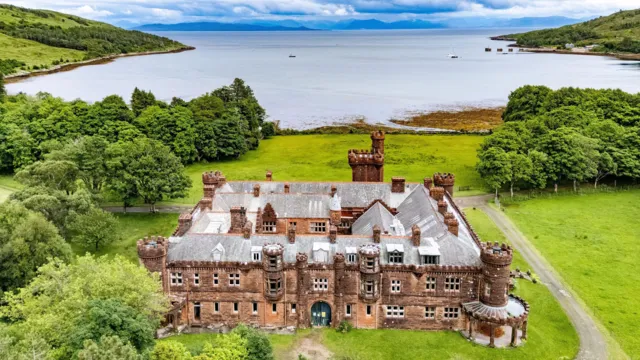
On the rugged Isle of Rum, just south of Skye, stands Kinloch Castle, a grand red sandstone building that once symbolised the height of Victorian luxury. With its ornate turrets, battlement-like rooftops, and sweeping views across the bay, it looks like something out of a romantic novel. But today, the castle is empty, weather-worn, and in desperate need of restoration. Once again, it has been put up for sale, this time with an asking price of offers over £750,000. The question is whether a buyer can be found who not only has the means to restore it, but also the vision to meet the needs of the small island community that calls Rum home.
Kinloch Castle was originally built between 1897 and 1900 for George Bullough, an English industrialist who wanted a lavish hunting lodge in the Hebrides. Designed by Leeming and Leeming, London-based architects best known for their commercial and municipal projects, it remains the only example of a house they ever created. Bullough spared no expense, filling the property with luxurious furnishings, carved wood, and artwork that gave it an almost palatial air. The castle’s grand design and opulence made it a talking point, not just on Rum but across Scotland.
However, the fortunes of Kinloch Castle changed drastically after World War One. The building slipped into decline, and by 1957 it had been taken over by the Nature Conservancy Council, the predecessor of today’s NatureScot, which now owns and manages the property. For decades it has remained in a fragile state, requiring extensive restoration work. There have been several proposals over the years to give the building a new lease of life. At one point, it was suggested it could be redeveloped into a 41-bedroom hostel. Another plan imagined it as a museum and visitor attraction, a £13 million project that never materialised.
Now the castle is back on the market, but the story is not as straightforward as it sounds. This is not the first time someone has attempted to buy it. Just two years ago, businessman and city financier Jeremy Hosking tried to purchase the property, but the sale collapsed amid controversy. Hosking, who is known as a former Tory donor, blamed then biodiversity minister Lorna Slater of the Scottish Greens for putting the deal on hold. Slater intervened after the Isle of Rum Community Trust raised concerns, saying there was little information about what Hosking planned for the castle. Feeling his ambitions had been blocked, Hosking eventually withdrew his offer in 2023, describing his conservation plans as “completely crushed.”
The renewed sale of Kinloch Castle comes at a time when debate about its future is very much alive. The Isle of Rum itself is small, with a population of about 40 people. For them, the fate of the castle is not just a matter of preserving an old building but about shaping the future of their community. Research conducted by the Scottish government’s Rural and Environment Science and Analytical Services suggests that most islanders believe the castle should indeed be sold, redeveloped, and brought back into use. At the same time, they have been very clear about the conditions they want attached to any sale.
Their expectations include active community involvement in how the property is managed and a requirement that the new owner respects land access rights. Some residents are hopeful that a responsible buyer could transform the castle into something that benefits both the island’s economy and its cultural life. Others, however, remain unconvinced. A smaller group of islanders would prefer to see the building transferred into community ownership, or even allowed to decay gracefully rather than risk it being bought by someone whose intentions do not align with the island’s values.
Chris Donald of NatureScot summed up the mood when he said, “Through this study, islanders made it clear that the most important aspect of any sale is a long-term commitment to contribute to the community and nature on the island. We are therefore asking prospective buyers to set out, alongside their offer, how they plan to use the castle and grounds and how they will support the nature, sustainability, culture and economy of the Isle of Rum.”
This adds a unique dimension to the sale. Buyers are not just being asked to put forward money; they are being asked to present a vision. Whoever takes on Kinloch Castle will need to show how they can blend heritage restoration with community development. It is, in a way, an invitation to become part of the island’s history, to preserve a landmark while also nurturing the fragile ecosystem and tight-knit population that surrounds it.
For the right buyer, this could be a rare opportunity. At £750,000, Kinloch Castle may cost less than a modest flat in parts of London, but the price of restoring it could run into many millions. The reward, however, would be the chance to rescue one of Scotland’s most iconic buildings and give it a purpose in the twenty-first century. Whether that turns out to be as a hotel, a museum, or even some entirely new venture, the project has the potential to redefine Rum’s place on Scotland’s cultural and tourist map.
Looking inside the castle today, its faded grandeur is still visible. Carved wooden banisters, mounted deer heads, and paintings hint at its former splendour, even if time has taken its toll. From the outside, its red sandstone walls and turrets still dominate the landscape, a reminder of when the island once played host to lavish hunting parties.
The challenge now is finding someone willing to look past the decay and see the possibility. For NatureScot, the sale is not just about offloading a burden but about finding a partner who will honour the castle’s history while breathing new life into it. For the islanders, it is about making sure that whoever buys Kinloch Castle respects their home and contributes to its survival.
Kinloch Castle has stood for more than a century, witnessing both glory and decline. Its future now hangs in the balance, waiting for someone with the resources, imagination, and respect to take it on. Whether such a buyer exists remains to be seen, but one thing is certain: the story of this Victorian treasure is far from over.




Responses