ACTIF2025 Seals Over $300 Million in Investment Deals

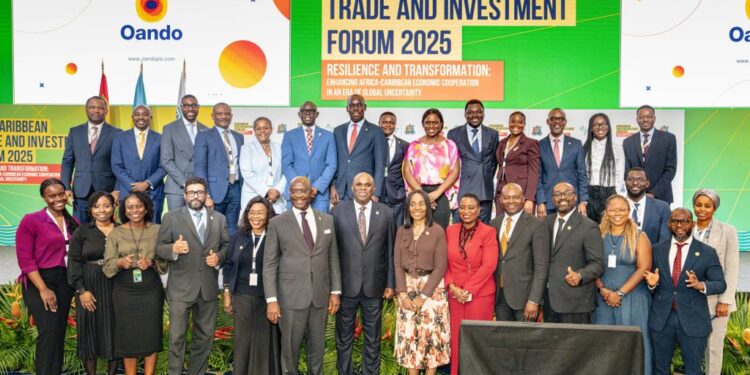
At the close of the fourth edition of the AfriCaribbean Trade and Investment Forum (ACTIF2025), a clear message emerged: Africa and the Caribbean are not just exploring new opportunities—they are actively building a stronger, more interconnected future. The event wrapped up with more than $300 million in trade and investment deals, reinforcing a growing commitment to collaboration across both regions.
The forum, jointly hosted by the African Export-Import Bank (Afreximbank) and the Government of Grenada, brought together a powerful mix of voices and ideas. Over 2,100 delegates from 80 countries participated, including 11 Heads of State and Government, as well as influential figures from the public and private sectors. Across two days of intense dialogue and networking, the forum served not just as a conference but as a catalyst for real economic action.
According to a statement published on Afreximbank’s official website, ACTIF2025 led to the signing of eight major deals and memoranda, cutting across various sectors such as infrastructure, tourism, digital transformation, and trade finance. These agreements are more than numbers on a sheet—they represent real, tangible steps toward boosting development in both regions.
Among the standout deals was a $100 million Receivables Discounting Facility signed with Bahamas Striping Group of Companies Ltd, aimed at enhancing road and infrastructure projects. In a separate agreement, Saint Kitts and Nevis secured a $50 million Education Construction and Rehabilitation Climate-Linked Facility, which will directly support the nation’s efforts to rebuild and modernize its schools in a climate-resilient way.
In the tourism space, a $61.25 million Term Loan was agreed upon for the Homewood Suites by Hilton Barbados, reinforcing the region’s ambition to grow its hospitality sector and attract higher volumes of international visitors.
Other significant transactions included a $40 million Receivables Facility for Cat Island Infrastructure Company Ltd in The Bahamas and another $40 million agreement to develop a commercial port through a partnership between Gemini Integrated Commodities Trading Company Ltd and the Government of Saint Kitts and Nevis.
Additionally, strategic cooperation was expanded through memorandums of understanding (MOUs) with institutions like the Grenada Development Bank—focused on empowering small and medium-sized enterprises—and the Caribbean Telecommunications Union (CTU) to accelerate digital transformation in the region.
To bolster cross-border financial operations, The Bank of The Bahamas Ltd was appointed as an Afreximbank Trade Finance Intermediary, an important step in ensuring that the financial infrastructure is equipped to support deeper inter-regional trade.
In his powerful closing speech, Grenada’s Prime Minister, Hon. Dickon Mitchell, spoke about the importance of creating lasting structures to support Africa-Caribbean economic relations.
He reminded attendees that the systems inherited from the colonial past were not designed to empower. “We have to be very deliberate about creating institutions that will, in fact, recreate the type of trade, investment, banking, and financial relationships that we want to build for ourselves,” he said. “The reality is, what was created before was meant to entrap us.”
He also made a strong call for free movement of people between Africa and the Caribbean, questioning the continued reliance on restrictive visa systems. “I see no valid reason for maintaining the visa systems… Biometrics allows us to move past that,” he said, emphasizing the role of technology in building trust and openness between nations.
From a financial and trade integration standpoint, Dr. George Elombi, Executive Vice President of Afreximbank and its incoming President, stressed that the time for justifying the vision is over. What’s needed now, he said, is belief and action.
“The next phase is not about justifying our vision, it should be about conviction. Believing further in who we are, where we want to be, and acting decisively,” he said. “Finance is the lifeline of trade. Once we integrate the payment systems and get them to see the Caribbean as the unique opportunity it is, the rest will follow.”
Beyond the deals and discussions, the forum also produced a comprehensive ACTIF2025 Communiqué, which outlined the collective intentions of participants moving forward. A key highlight was the support for the Global Africa Commission, endorsed by Grenada, Saint Kitts and Nevis, and other member states of the Organisation of Eastern Caribbean States (OECS). The commission is expected to help streamline trade, cultural, and investment relations between Africa and its diaspora.
The communiqué also reflected strong support for:
-
Establishing a Free Trade Arrangement between Africa and the Caribbean
-
Eliminating visa restrictions to boost people-to-people connectivity
-
Expanding air and maritime links for easier trade and travel
-
Strengthening partnerships in digital innovation, sports, and the creative economy
These ambitions are part of a larger vision to create “resilient cross-regional value chains” that benefit all parties involved. With the formal announcement of ACTIF2026, the forum is set to continue as a recurring platform for collaboration and progress.
The results of ACTIF2025 show that Africa and the Caribbean are serious about charting a new course—one rooted in mutual respect, shared opportunity, and proactive engagement. These are not just symbolic gestures. The commitments made and the money mobilized at the forum will help finance real projects, employ real people, and improve real lives.
In a world where many regions are retreating into isolationism, the bold steps taken at ACTIF2025 are a reminder that cooperation still has the power to transform futures. Whether it’s building roads in the Bahamas, modernizing education in Saint Kitts, or financing ports and hotels across the islands, the foundation for something big is being laid.
Africa and the Caribbean, once connected by painful histories, are now building a future bound by purpose, vision, and mutual prosperity.





Responses