“Alex Otti Didn’t Build Those Roads”: Doris Ogala’s Defence of Orji Uzor Kalu Sparks Fierce Political Debate in Abia

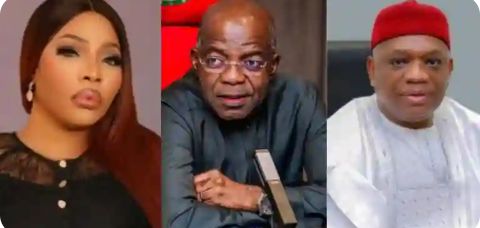
A fresh political storm has erupted in Abia State following comments by Nollywood actress Doris Ogala, who publicly defended former governor and current senator, Orji Uzor Kalu, against criticism directed at him over his remarks about Governor Alex Otti’s performance in office. What began as a straightforward political disagreement quickly snowballed into a heated online debate, drawing in supporters and critics from across party lines, while also exposing deep divisions over governance, legacy projects, and political loyalty in the state.
The controversy started when Senator Orji Uzor Kalu openly accused Governor Alex Otti of being largely inactive since assuming office. According to Kalu, the current administration has not initiated any major infrastructural projects but is instead repainting, rehabilitating, and rebranding roads that were originally constructed during his own tenure as governor of Abia State. He insisted that what is being showcased as new achievements are, in reality, old projects receiving cosmetic upgrades.
Doris Ogala, reacting to the senator’s comments, took to her Instagram page to back him unequivocally. Describing Orji Uzor Kalu as “my boss,” the actress stated that his claims were factual and should not be dismissed. She argued that many of the roads currently being highlighted by the Alex Otti administration were originally built during Kalu’s years in office and are now merely being repainted and presented as new achievements.
Her statement immediately triggered intense reactions across social media and online forums. Supporters of Orji Uzor Kalu praised Ogala for what they described as “speaking the truth,” insisting that history should not be rewritten for political convenience. They echoed the argument that several roads being commissioned today existed long before Otti became governor and accused the current government of relying heavily on media hype rather than substantive new projects.
However, critics were far more vocal and aggressive. Many dismissed Doris Ogala’s intervention as unnecessary and accused her of seeking relevance by inserting herself into Abia State politics. Some commenters questioned her credibility and motivations, while others launched personal attacks, arguing that entertainers should stay out of governance matters. The backlash quickly moved beyond politics into personal territory, reflecting how polarized and toxic political discussions have become.
Beyond the actress herself, Governor Alex Otti became the central figure of the debate. His supporters strongly defended his administration, arguing that road rehabilitation is a legitimate and necessary form of infrastructure development, especially considering the years of neglect under successive governments after Orji Uzor Kalu left office over a decade ago. They maintained that many roads built in the early 2000s would have significantly deteriorated by the time Otti assumed office, making full-scale rehabilitation unavoidable.
Several contributors pointed out that Otti has been deliberate in his choice of words, often referring to such projects as “rehabilitation” rather than outright construction. To them, this shows transparency rather than deception. They also credited Otti with restoring some level of order, accountability, and visible governance to Abia after what they described as disastrous administrations under Theodore Orji and Okezie Ikpeazu.
On the other hand, critics of the governor accused him of excessive publicity, alleging inflated project costs and questioning claims surrounding expenditures on smart schools, pension payments, and minimum wage implementation. Some even argued that focusing on short road stretches was a strategy to divert attention from deeper governance failures. Comparisons were drawn with governors in other states who, according to them, were quietly delivering longer and more impactful projects without constant media fanfare.
As the argument expanded, it also exposed wider political fault lines, including party loyalties, the influence of “Obidient” politics, and lingering resentment from national elections. What was initially a debate about roads evolved into a broader contest over credibility, governance standards, and the direction of Abia State.
In the end, Doris Ogala’s comments achieved one undeniable outcome: they reignited public scrutiny of both Orji Uzor Kalu’s legacy and Alex Otti’s record in office. While opinions remain sharply divided, the episode underscores a familiar Nigerian political reality — that infrastructure, history, and perception are deeply contested, and that in the court of public opinion, even a coat of fresh paint can spark a full-blown political war.


Responses