Army Kills ISWAP Commander, Abou Ameer, During Failed Attack In Adamawa

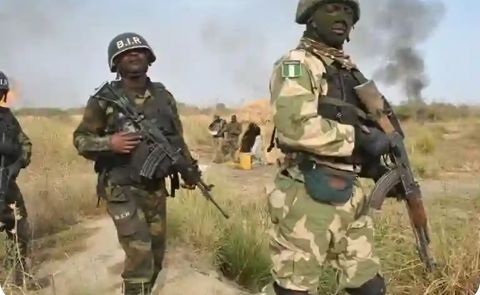
Troops of the Nigerian Army have reportedly neutralised a senior commander of the Islamic State West Africa Province, identified as Abou Ameer, during a failed infiltration attempt in Madagali Local Government Area of Adamawa State.
According to security sources cited by counter-insurgency platform Zagazola Makama, the insurgent leader was leading a group of fighters attempting to breach a military formation when they were met with heavy resistance from troops. The operation reportedly resulted in significant casualties among the insurgents.
Abou Ameer was said to have been recently appointed as the ISWAP “Qaid” (commander) in Pulka, following the earlier killing of his predecessor, Modu Kunduli, in Bama Local Government Area of Borno State. His elimination marks another blow to the leadership structure of the group, which has faced sustained military pressure in Nigeria’s North-East region.
Military sources revealed that the troops engaged the insurgents with coordinated firepower, successfully repelling the attack. Several other high-ranking ISWAP members, including Abu Ali Jango, Jundulla, and Saleh Madagali, were reportedly wounded during the clash.
In addition to neutralising key fighters, soldiers recovered weapons and intelligence materials from the scene. These findings are expected to aid ongoing military operations and provide insight into the group’s strategies and movements.
The development comes shortly after a separate joint operation involving the Nigerian Army and the Nigerian Air Force reportedly led to the killing of at least 61 ISWAP fighters during another failed infiltration attempt in Malam Fatori, located in Abadam LGA of Borno State. These back-to-back operations highlight intensified efforts by Nigerian security forces to weaken insurgent networks operating within the Lake Chad Basin.
Security analysts say the repeated targeting of ISWAP leadership is part of a broader counter-insurgency strategy aimed at disrupting command structures and reducing the operational effectiveness of the group. However, they also note that such groups often replace fallen leaders quickly, making sustained military pressure and intelligence-driven operations crucial for long-term success.
The North-East region of Nigeria has remained a hotspot for insurgency over the past decade, with both ISWAP and Boko Haram factions carrying out attacks on military positions and civilian communities. Despite recent gains by security forces, challenges such as difficult terrain, cross-border movements, and logistical constraints continue to complicate efforts to fully eliminate the threat.
Nevertheless, the latest operation in Adamawa is being viewed as a tactical success for the Nigerian military, demonstrating improved coordination and responsiveness to insurgent activities. Authorities maintain that continued offensives, combined with intelligence gathering and regional cooperation, will be key to restoring lasting peace in the affected areas.





Responses