G20 Summit in South Africa Adopts Controversial Declaration Without U.S. Backing, Triggering Diplomatic Tensions

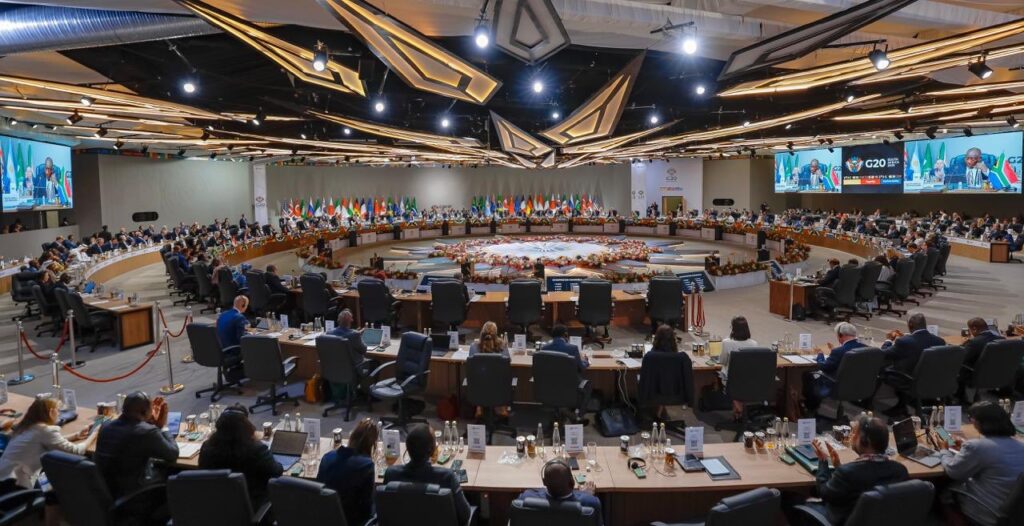
The Group of 20 (G20) leaders’ summit held in Johannesburg, South Africa, concluded with the adoption of a major declaration addressing climate change, global economic strains, and geopolitical instability. However, the outcome was overshadowed by controversy as the document was finalized without the participation of the United States, prompting strong criticism from Washington and amplifying ongoing diplomatic friction with the host nation.
The summit, hosted by President Cyril Ramaphosa, was intended to showcase South Africa’s leadership as the first African country to hold the G20 presidency. According to Ramaphosa’s team, negotiations for the declaration had been underway throughout the year, with the final week described as particularly intense. Despite this long process, the United States withdrew from the drafting phase in protest over the language used regarding climate issues and other global concerns.
White House officials denounced the move, calling it “shameful,” and arguing that South Africa had abandoned the G20 tradition of producing only consensus-based documents. A senior Trump administration official stated that issuing a declaration without unanimous agreement undermined the credibility of the group and signaled a disregard for established protocol.
Nonetheless, Ramaphosa’s spokesperson Vincent Magwenya emphasized that the declaration “cannot be renegotiated,” and insisted that there was “overwhelming consensus” among G20 members present. He added that the U.S. objection would not derail the collective decision of the majority.
The negotiations faced another unexpected complication when Argentina, under its far-right president Javier Milei—a staunch ally of U.S. President Donald Trump—walked out shortly before the document was finalized. Although Argentina did not block its adoption, Foreign Minister Pablo Quirno announced that his country could not endorse the declaration due to concerns about its reference to the Middle East conflict. Quirno argued that the document simplified a complex and sensitive issue, especially its mention of the need for a “just and lasting peace in the Occupied Palestinian Territory.” Still, Argentina reaffirmed its commitment to the G20’s longstanding spirit of cooperation.
One of the most contentious elements of the declaration was its firm language on climate change. The text describes global warming as a critical threat and calls for ambitious investments in renewable energy, increased climate adaptation, and urgent support for developing nations overwhelmed by debt burdens. These positions sharply contradict the Trump administration’s stance, which rejects the scientific consensus on human-caused climate change. U.S. officials had indicated they would oppose any declaration including climate commitments.
During the summit’s opening remarks, Ramaphosa stressed the importance of maintaining the dignity and influence of the first African-hosted G20. His assertive tone was notably different from his earlier interactions with President Trump, including a tense meeting at the White House where Trump repeated widely debunked claims about a “genocide of white farmers” in South Africa.
The diplomatic atmosphere was further strained by Trump’s refusal to attend the summit. The U.S. president declared he would boycott the event over allegations—discredited by international observers—that South Africa’s Black-majority government was persecuting its white minority population. South Africa rejected these claims as politically motivated and unfounded.
Despite the disagreements, the summit proceeded with its agenda, focusing on the need for global cooperation in the face of rising geopolitical tensions, including Russia’s war in Ukraine and contentious climate negotiations ahead of COP30. The European Union, represented by Ursula von der Leyen, raised concerns over the “weaponization of dependencies,” referencing China’s restrictions on rare earth exports essential for renewable energy and defense technologies.
One final diplomatic dispute emerged over the upcoming 2026 U.S. presidency of the G20. South Africa rejected Washington’s suggestion to send a chargé d’affaires to receive the symbolic handover, insisting the gesture breached protocol. Officials later confirmed that South Africa would assign a diplomat of equal rank for the formal transition.
The summit closed with the adopted declaration—one that revealed deep divisions but also reflected the determination of many member states to push forward on global climate and development priorities, even without U.S. approval.



Responses