Kidnapping Crisis Deepens Across Nigeria: 145 Reported Cases in October 2025


Nigeria continues to grapple with an alarming rise in insecurity, as new data reveals that 145 cases of kidnapping were reported nationwide in October 2025 alone. The figures, shared by a data analyst identified as DrMB and verified by #TheCableIndex using the National Human Rights Commission’s (NHRC) records, paint a grim picture of regional security challenges.
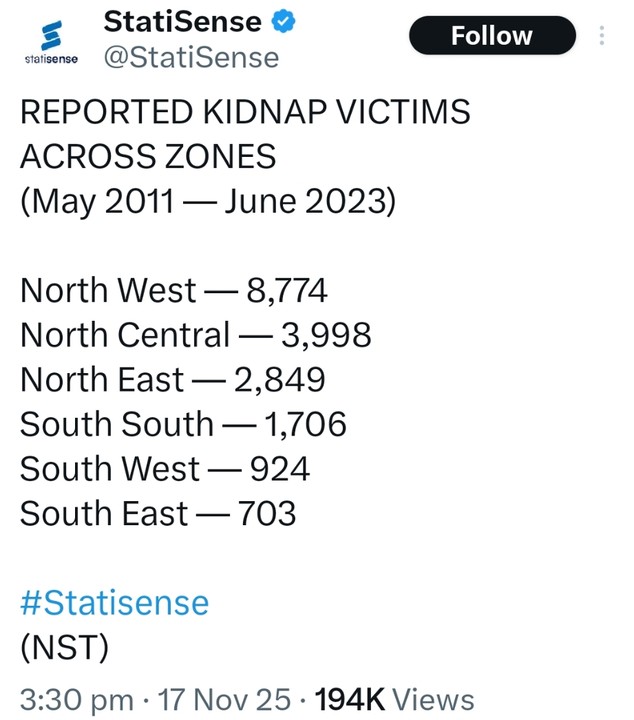
According to the report, the North-West and North-Central zones remain the epicentres of the kidnapping epidemic, accounting for an overwhelming 124 out of the total 145 incidents. The breakdown shows the North-West recording 75 cases, while the North-Central followed with 49. The North-East logged 11, while the South-East and South-South each had 4. The South-West, which includes Lagos, Ogun, and Oyo, recorded just 2 incidents — the lowest in the country.
Analysts and citizens alike have expressed deep concern over the data, describing it as both “stark” and “disturbing.” The figures, though shocking, are believed to represent only a fraction of the true scale of the problem, as many abductions go unreported due to fear, mistrust in law enforcement, and the normalization of criminal activity in some areas.
Several Nigerians reacting to the data on public forums argued that the southern regions’ numbers appeared suspiciously low, insisting that the real figures are underreported. A commenter identified as helinues noted, “There are so many unreported cases, most especially in Southern Nigeria.” Another user, atobs4real, echoed this sentiment, suggesting that “the ones not reported are even higher than this.”
Meanwhile, others took the discussion in a political direction. A user named immaculatesense highlighted the comparative peace in the South, arguing that “the southern region is very peaceful. It should be a country on its own or better still, countries of their own maintaining peaceful neighborhoods.” This sentiment reflects a growing frustration among citizens who believe that Nigeria’s current structure cannot effectively address insecurity.
Some participants also criticized government inefficiency and the lack of accurate data collection. tuborme, commenting on the issue, lamented that “data in Nigeria is a mess because the government doesn’t use them. The reason why it is not used is because we are largely ruled by illiterates or uneducated literates.”
On the other hand, several voices from the northern part of the country acknowledged that the North-West and North-Central have become kidnapping hotspots. Roads linking Kaduna, Niger, Zamfara, and Kogi States are notorious for daily abductions, with criminal gangs often targeting motorists, commuters, and rural communities. Reports suggest that many of these kidnappings are motivated by ransom, while others are linked to banditry and communal conflicts.
Security experts argue that the persistence of kidnappings underscores the federal government’s inability to implement effective countermeasures. Despite several high-profile military operations, community policing initiatives, and state-level interventions, armed groups continue to operate with near impunity.
focus7, another commenter, drew attention to the normalization of kidnapping in parts of the South-East: “Kidnapping has long become a normalized menace in the region, especially in Anambra State. It evolved into an organized business as far back as Peter Obi’s tenure as governor.” This highlights how the crime, which once seemed isolated to specific northern zones, has become a nationwide crisis affecting all six geopolitical regions.
Calls for restructuring and regional autonomy also surfaced in the online debate. Some citizens, like thisisit, proposed dividing the country into separate republics—Arewa, Biafra, Niger Delta, Oduduwa, and Middle Belt—to enable localized governance and more effective security responses.
While such suggestions remain controversial, they reflect a growing loss of confidence in the federal structure’s ability to protect lives and property.
Ultimately, the October 2025 kidnapping data exposes more than just numbers — it reveals a fractured nation where insecurity, poor governance, and mistrust have become daily realities. As one commenter bluntly put it, “National problems can’t be solved with national lies.” Without credible data, coordinated security reform, and political will, Nigeria risks normalizing kidnapping as a way of life — a fate no country should accept.





Responses