Lagos Flooded with Tinubu Family Posters as Isaac Fayose Raises Alarm

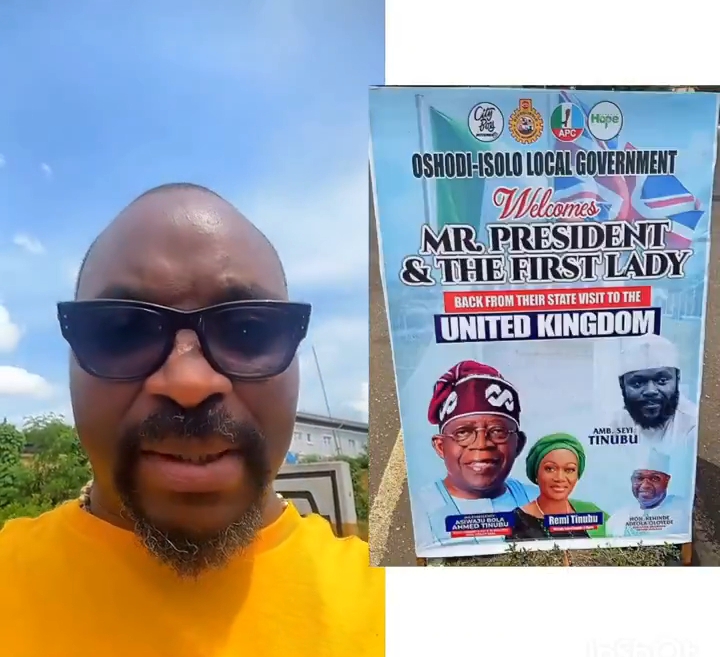
Businessman and activist Isaac Fayose has sparked fresh political debate after publicly criticizing the widespread display of posters featuring President Bola Tinubu, First Lady Oluremi Tinubu, and their son Seyi Tinubu across various parts of Lagos State.
The posters, which appeared shortly after the president’s return from an official visit to the United Kingdom, were reportedly meant as a show of support and welcome gesture rather than formal campaign materials. However, their prominence and the inclusion of multiple members of the president’s family have triggered mixed reactions, with Fayose emerging as one of the most outspoken critics.
In a video circulating online, Fayose expressed surprise and concern as he drove through Lagos, pointing out the posters and questioning their implications. Speaking in Pidgin English, he suggested that the imagery created the impression of a family-centered leadership structure. According to him, the repeated display of the president alongside his wife and son across the city sends a troubling message about the direction of governance.
Fayose went further to question whether such a development was normal in a democratic setting, arguing that it could be interpreted as a sign of growing political influence concentrated within a single family. He described the situation as unprecedented, warning against what he portrayed as the emergence of a “family-style” political system.
Beyond the symbolism of the posters, Fayose also used the opportunity to criticize broader issues within the current administration. He linked the situation to rising economic hardship, referencing the increasing cost of living and the struggles faced by ordinary Nigerians. In his remarks, he suggested that government responses to citizens’ challenges often appear superficial, alleging that short-term relief measures fail to address deeper structural problems.
He also revisited the controversial removal of fuel subsidies, questioning the transparency of the savings that were promised as a result of the policy. According to Fayose, Nigerians were told that subsidy removal would lead to significant financial gains for the country, but he argued that the expected benefits have not been clearly accounted for.
In addition, Fayose raised concerns about political alignments within the country, alleging that some governors who have recently aligned with the ruling All Progressives Congress (APC) may be acting out of personal interest rather than public service. He suggested that such political movements could be driven by attempts to avoid scrutiny rather than genuine ideological alignment.
The activist also questioned the public role of Seyi Tinubu, noting that while he remains a private citizen, his increasing visibility in political spaces has drawn attention. This comes amid growing speculation about his potential political ambitions, particularly in Lagos State, where some groups have reportedly begun promoting him as a possible candidate in future elections.
Fayose concluded his remarks by urging Nigerians to remain vigilant and actively participate in the democratic process. He encouraged citizens not to be intimidated or discouraged, emphasizing the importance of collective action through voting.
The emergence of the posters has since fueled wider conversations on social media and beyond, with opinions sharply divided. While some view the displays as harmless expressions of support for the president, others see them as excessive and indicative of a broader culture of political loyalty and personality-driven governance.
As discussions continue, the incident highlights ongoing concerns about political messaging, public perception, and the evolving dynamics of power within Nigeria’s democratic landscape.




Responses