Northern States Dominate List of Nigerian States With Highest Number of Unqualified Teachers

New statistics released by the Federal Ministry of Education have revealed that several states in northern Nigeria account for the highest number of public primary school teachers who lack formal teaching qualifications.
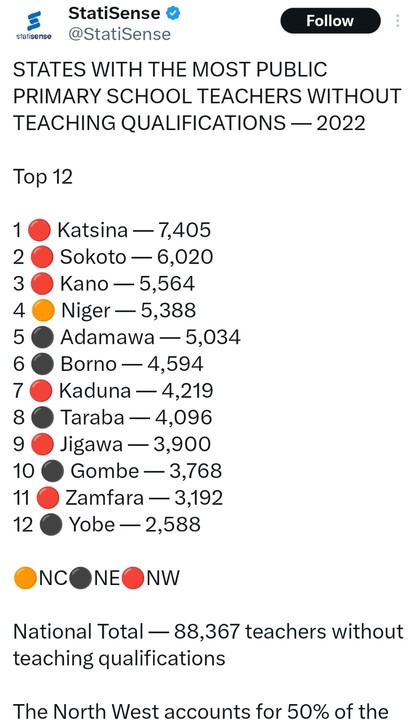
According to data compiled for 2022 and shared by the data platform Statisense, a total of 88,367 teachers across the country’s public primary school system do not possess the required professional teaching credentials.
The figures highlight a major challenge within Nigeria’s basic education sector, where many teachers currently working in classrooms were not formally trained in education.
States With the Highest Numbers
The data shows that the largest concentrations of unqualified teachers are found in states in the North-West and North-East geopolitical zones.
Leading the list is Katsina State with 7,405 teachers without teaching qualifications.
It is followed by:
-
Sokoto State — 6,020
-
Kano State — 5,564
-
Niger State — 5,388
-
Adamawa State — 5,034
-
Borno State — 4,594
-
Kaduna State — 4,219
-
Taraba State — 4,096
-
Jigawa State — 3,900
-
Gombe State — 3,768
-
Zamfara State — 3,192
-
Yobe State — 2,588
Of the twelve states listed, six are located in the North-West, five are in the North-East, and one belongs to the North-Central region.
What “Unqualified” Means
Education experts note that the term “unqualified teacher” does not necessarily mean the individual lacks a university degree. Rather, it refers to teachers who do not possess professional training in education, such as the Nigeria Certificate in Education (NCE) or other recognized teaching qualifications.
In many cases, individuals trained in other fields—such as engineering, sciences, or social sciences—are employed to teach in schools without formal pedagogical training.
While such individuals may possess academic knowledge, education specialists argue that teaching requires specialized training in classroom management, child psychology, curriculum delivery, and assessment methods.
Implications for Basic Education
Nigeria’s public primary school system forms the foundation of the country’s education structure, making teacher quality a critical factor in learning outcomes.
The statistics raise concerns about the ability of many schools to deliver effective education, particularly in rural areas where teacher shortages are more severe.
In regions affected by insecurity, such as parts of the North-East, the problem has been compounded by school closures, displacement of communities, and the destruction of educational infrastructure.
Government Efforts to Address the Gap
Authorities have previously introduced initiatives aimed at improving teacher quality nationwide. Programs under the Universal Basic Education Commission (UBEC) include teacher training, recruitment drives, and capacity-building workshops.
Some state governments have also launched teacher competency tests and recruitment reforms in an effort to raise professional standards within public schools.
However, education analysts say the scale of the problem suggests that sustained investment in teacher training, recruitment, and educational infrastructure will be necessary to close the gap.
Wider Debate
The data has also reignited broader conversations about educational inequality in Nigeria. Observers note that regional disparities in literacy rates, school enrollment, and access to qualified teachers have persisted for decades.
Addressing these challenges, experts say, will require coordinated efforts by federal and state governments to strengthen teacher training institutions and ensure that qualified educators are available in every classroom across the country.


Responses