PDP Slams Tinubu Over Kebbi School Abductions, Questions Whether Nigeria Must Be Shamed by Foreign Powers Before Action Is Taken

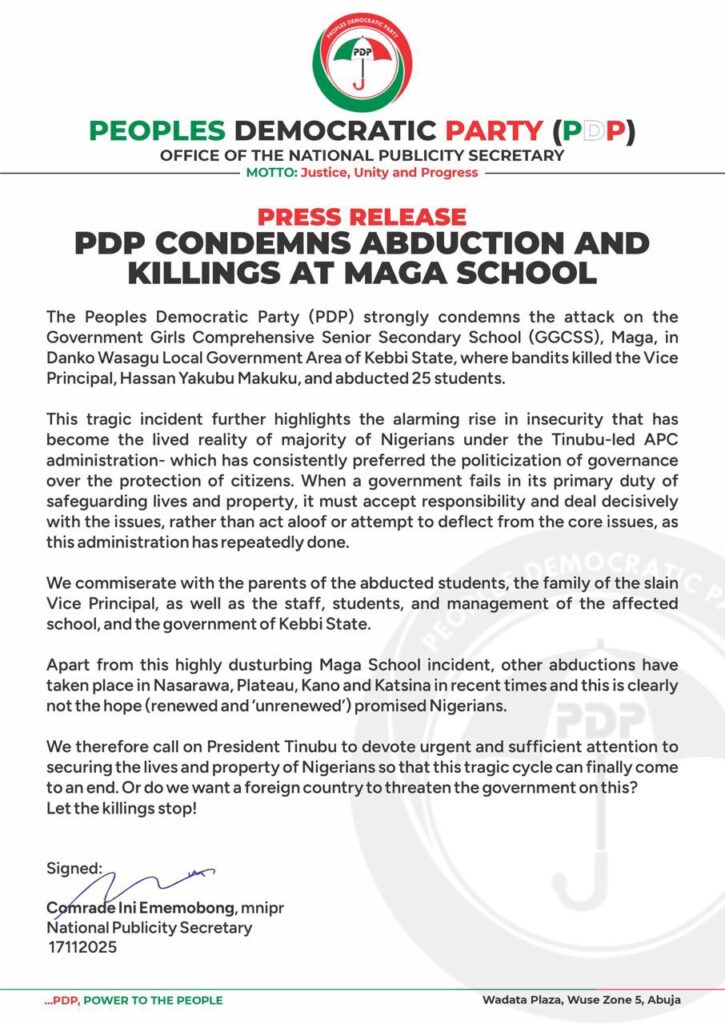
The Peoples Democratic Party (PDP) has sharply criticized the administration of President Bola Ahmed Tinubu following the tragic abduction of 25 female students at the Government Girls Comprehensive Senior Secondary School (GGCSS), Maga, in Danko-Wasagu Local Government Area of Kebbi State. The party issued a strongly worded statement condemning what it described as a renewed surge in violent attacks across the country, lamenting that the government has failed in its constitutional responsibility to protect citizens.
According to the PDP’s press release, signed by its National Publicity Secretary, Comrade Ini Ememobong, the party expressed deep sorrow over the killing of the school’s Vice Principal, Hassan Yakubu Makuku, who reportedly attempted to defend the students during the attack. The bandits, operating with increasing boldness in the region, stormed the school in the early hours of the morning, unleashing fear and chaos before abducting dozens of schoolgirls.
The opposition party noted that the Maga incident is only one in a series of disturbing developments. Over the past few weeks, similar abductions have occurred in Nasarawa, Plateau, Kano, and Katsina States. For the PDP, this pattern demonstrates that insecurity is not only persistent but escalating, in sharp contradiction to the “renewed hope” promised by the current administration.
In its statement, the PDP accused the Tinubu-led government of prioritizing political optics over the safety of Nigerians. It argued that the administration behaves as though it prefers to appear unconcerned, even as citizens grapple daily with fear, loss, and unpredictable violence. The party insisted that a serious government would take responsibility, mobilize resources, and demonstrate urgency in tackling the nation’s security challenges, rather than acting “aloof” or offering excuses.
The party also raised a pointed and controversial question: “Do we want a foreign country to threaten the government again before action is taken?” This line appears to reference previous instances when international condemnation—particularly from the United States and the United Kingdom—placed pressure on Nigerian authorities to accelerate rescue operations or address human rights violations. The PDP suggested that the Tinubu administration should not wait for another round of global embarrassment before acting decisively.
The opposition party extended condolences to the families of the abducted girls, the relatives of the slain Vice Principal, as well as the staff and management of the affected school. They called for urgent federal intervention to bring the children home safely and restore security in communities terrorized by bandits.
The press release stirred significant debate among Nigerians. Some praised the PDP for finally finding its voice and taking a firm stance against insecurity. Others expressed skepticism, arguing that opposition parties are only loud when out of power. Several commenters suggested that the ruling APC appears overwhelmed by the scale and complexity of the nationwide security crisis. Others questioned why political leaders seem more focused on political defections and ceremonies than the safety of students and rural communities.
Many citizens stressed that the pattern of attacks on schools—particularly girls’ schools—resembles earlier tragedies such as the Chibok abductions. They noted with concern that the very politicians who once led public campaigns like Bring Back Our Girls are now in power but appear unable to prevent a recurrence of equally devastating incidents.
Some forum participants also emphasized that the attacked school is a Christian institution, calling on local and international actors to highlight this fact. They argued that failing to acknowledge the religious identity of targeted communities contributes to downplaying a pattern of attacks that often disproportionately affect Christian schools in the northwest and north-central regions.
The PDP concluded its message by demanding that President Tinubu show leadership, restore public confidence, and end what it described as a “tragic cycle” of killings and abductions. Their closing statement was emphatic: “Let the killings stop!”




Responses