Sowore Sparks Debate Over Judicial Independence and Alleged Gifts to Judges

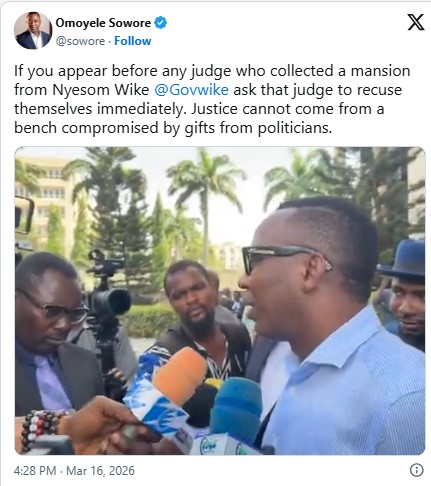
Human rights activist and former presidential candidate Omoyele Sowore has stirred fresh controversy after urging Nigerians to challenge the neutrality of judges who may have benefited from alleged gifts linked to the Minister of the Federal Capital Territory, Nyesom Wike.
In a statement that quickly gained traction online, Sowore advised litigants to request the recusal of any judge suspected of receiving a mansion from Wike, arguing that justice cannot be guaranteed if the bench is compromised by political influence. According to him, any form of material benefit from a political office holder raises serious ethical concerns and could undermine confidence in the judiciary.
His comments come amid ongoing public conversations about the relationship between Nigeria’s executive arm and the judiciary, particularly regarding welfare provisions such as official residences for judges.
Divided Public Opinion
Reactions to Sowore’s statement have been sharply divided.
Supporters of his position argue that even if such houses are provided under government policy, the optics are troubling. They believe that when a political figure is seen to directly facilitate benefits for judges, it creates a perception of bias—even if no wrongdoing is proven. For them, judicial independence must not only exist but also be seen to exist.
Others insist that Sowore’s remarks are misguided. They argue that providing accommodation for judges is part of improving the welfare of the judiciary and should not automatically be interpreted as bribery or undue influence. In their view, judges, like other top public officials, are entitled to official residences that reflect the importance of their roles.
The Core Issue: Conflict of Interest
At the heart of the debate is the principle of judicial independence, a cornerstone of any democratic system. Critics of the alleged arrangement say that if members of the executive arm are directly involved in providing benefits to judges, it risks blurring the line between separate arms of government.
Legal ethics generally require that judges avoid not only actual bias but also situations that could reasonably give rise to perceived bias. This is why recusal—stepping away from a case—is often recommended when there is a potential conflict of interest.
Sowore’s suggestion aligns with this principle: if there is any doubt about a judge’s impartiality, it is safer for that judge to withdraw from the case to preserve public trust.
Broader Concerns About Governance
The controversy has also reignited wider discussions about governance and accountability in Nigeria. Some commentators point out that similar benefits are not always extended to other critical sectors such as healthcare, education, or law enforcement, raising questions about government priorities.
Others counter that strengthening the judiciary is essential for maintaining the rule of law, and improving judges’ welfare could help reduce corruption within the system.
A Persistent Debate
This is not the first time issues surrounding the independence of Nigeria’s judiciary have come under scrutiny. Allegations of political interference, whether proven or not, tend to generate strong public reactions because of their implications for justice and democracy.
While there is no official confirmation in this instance that any improper transactions took place, Sowore’s statement has succeeded in drawing attention to an important question: how can Nigeria ensure that its judiciary remains both independent and publicly trusted?
As discussions continue, the issue highlights a delicate balance—between providing adequate support for judicial officers and maintaining a clear separation from political influence.





Responses