
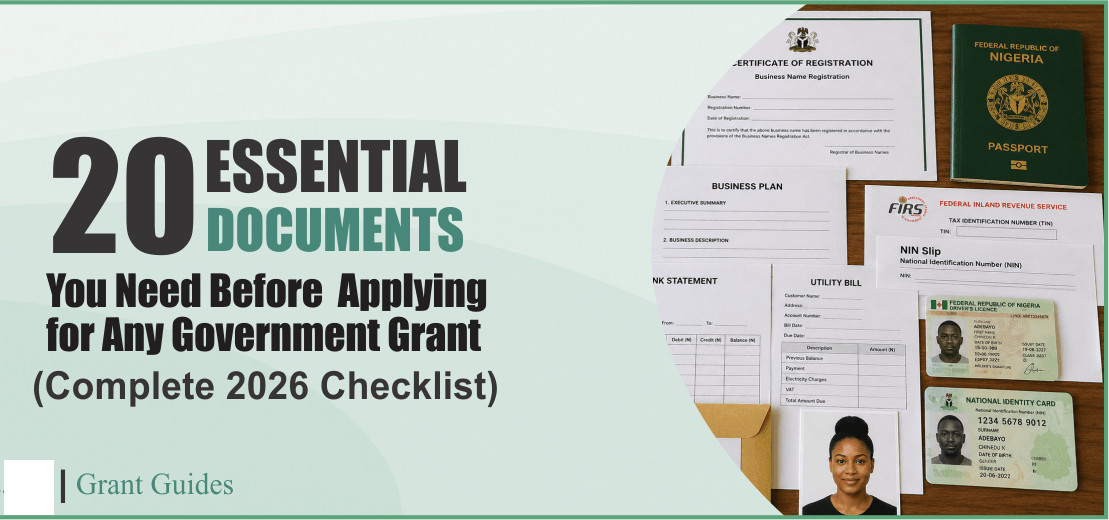
Government grants can provide valuable financial support for entrepreneurs, farmers, students, artisans, startups and community organizations. Yet, every year, many qualified Nigerians miss out because they submit incomplete applications or fail identity verification.
Most grant providers have strict application requirements. If a required document is missing or contains information that doesn’t match your application, you could be disqualified even if you meet all the eligibility criteria.
The good news is that you don’t have to wait until applications open before getting ready. Having your documents organised in advance allows you to apply quickly, avoid unnecessary stress and improve your chances of success.
This guide explains the key documents commonly requested in Nigerian government grant programmes, why they matter and how to prepare them properly.
Why You Should Prepare Your Documents Before a Grant Opens
Popular government grants often attract tens or even hundreds of thousands of applications within a few days.
Applicants who already have their documents ready can submit their applications early, while others spend valuable time trying to obtain missing paperwork.
Preparing ahead can help you:
- Apply before the deadline.
- Avoid last-minute mistakes.
- Speed up the verification process.
- Reduce the risk of disqualification.
- Submit a more professional application.
Although every programme has its own requirements, the following documents are among the most commonly requested.
1. Valid Means of Identification
Almost every government grant begins with identity verification.
Accepted identification usually includes:
- National Identity Card
- International Passport
- Driver’s Licence
- Permanent Voter’s Card
Your ID should be valid, easy to read and bear the same name used on your application.
2. National Identification Number (NIN)
Many federal and state government programmes now require applicants to provide their National Identification Number.
The NIN helps organisers:
- Confirm your identity.
- Detect duplicate applications.
- Match your personal records.
Before applying, make sure your NIN details match the information on your other documents.
3. Bank Verification Number (BVN)
Some grant programmes request your BVN as an additional security measure.
It is commonly used to verify that applicants are genuine and to reduce fraudulent applications.
Only provide your BVN through official government portals or approved application platforms.
4. Personal Bank Account Details
Most government grants pay successful applicants directly into their bank accounts.
Prepare the following information:
- Bank name
- Account name
- Account number
Using an account that belongs to someone else may delay payment or affect your application.
5. Recent Passport Photograph
A passport photograph is often required for identification purposes.
Use a recent photograph with:
- A plain background
- Good lighting
- Clear facial appearance
- No heavy editing or filters
Poor-quality photographs may be rejected during verification.
6. Proof of Residential Address
Some grant programmes ask applicants to prove where they live.
Documents that may be accepted include:
- Utility bills
- Tenancy agreement
- Bank statement showing your address
- Local government residency documents
Always check the specific requirements for the programme you are applying for.
7. Utility Bill
A recent electricity, water or waste disposal bill is commonly accepted as evidence of residence.
Many organisations prefer bills issued within the last three months.
If you don’t have a utility bill in your name, check whether the programme accepts alternative proof of address.
8. CAC Registration or Business Certificate
Business grants often require proof that your enterprise is legally recognised.
Depending on your business structure, this may include:
- Business Name Registration
- Certificate of Incorporation
- Other Corporate Affairs Commission (CAC) documents
However, many grants designed for petty traders, artisans and start-ups do not require CAC registration.
Take Advantage of this : SMEDAN Opens Free CAC Business Name Registration for 250,000 Nigerian Businesses – See Direct Application Link
9. Tax Identification Number (TIN)
Certain grants for registered businesses may request a Tax Identification Number.
This helps funding agencies verify tax records where applicable.
If the programme does not specifically mention a TIN, there may be no need to provide one.
10. Business Plan
A business plan is one of the most important documents for entrepreneurship grants.
It should explain:
- What your business does.
- The products or services you offer.
- Your target customers.
- How the grant will be used.
- Your expected growth.
Keep it realistic and easy to understand. A clear plan usually makes a stronger impression than one filled with unnecessary technical language.
11. Financial Records
Some funding organisations want evidence that your business is active.
Useful documents include:
- Sales records
- Cash flow statements
- Profit and loss reports
- Income records
These documents help demonstrate how your business operates and how grant funding could support its growth.
12. Curriculum Vitae (CV)
Grants aimed at graduates, professionals, researchers or youth development programmes may require a CV.
An updated CV should include:
- Educational qualifications
- Employment history
- Professional experience
- Relevant skills
- Awards or certifications
13. Educational Certificates
Education-focused grants and scholarship schemes usually request academic documents.
Examples include:
- WAEC, NECO or NABTEB certificates
- ND, HND or degree certificates
- Professional qualifications
- Other recognised educational credentials
14. Admission Letter or Student Identification
Students applying for educational grants may also need to provide:
- Admission letter
- Student identity card
- Proof of current enrolment
These documents confirm that you are actively studying.
15. Proof of Business Ownership
Some programmes ask applicants to demonstrate ownership of the business they claim to operate.
Evidence may include:
- CAC registration documents
- Partnership agreements
- Ownership certificates
This helps reduce false claims during the application process.
16. Reference Letter
Certain grants require recommendations from individuals who can verify your character or experience.
Suitable referees may include:
- Employers
- Community leaders
- Religious leaders
- Professional associations
Choose someone familiar with your work rather than someone with a prominent title who barely knows you.
17. Project Proposal
If you are seeking funding for a community project, research initiative or social enterprise, you may need a proposal.
A good proposal should clearly describe:
- The problem you want to solve.
- Your proposed solution.
- Expected outcomes.
- Timeline.
- Estimated cost.
Keep the language simple and focus on measurable impact.
18. Budget Estimate
Grant providers usually want to know exactly how their funds will be spent.
Your budget should clearly show expected expenses such as:
- Equipment
- Raw materials
- Transportation
- Staff costs
- Training
- Marketing
A detailed budget demonstrates planning and accountability.
19. Supporting Evidence
Additional documents can strengthen your application.
Examples include:
- Photographs of your business
- Customer testimonials
- Product samples
- Previous project reports
- Awards or recognition
These materials provide evidence that your business or project is genuine.
20. Completed Application Form
The application form is just as important as the supporting documents.
Before submitting:
- Read every instruction carefully.
- Check that your names match across all documents.
- Review dates, phone numbers and account details.
- Ensure uploaded files are correct.
- Submit before the deadline.
Many applications are rejected simply because applicants overlook small errors.
How to Submit a Strong Grant Application
Having the right documents is only one part of a successful application.
You should also:
- Read the eligibility requirements before applying.
- Use only official government websites or recognised application portals.
- Keep scanned copies of important documents.
- Save files in PDF format where required.
- Label digital files clearly.
- Ensure all documents are clear and readable.
- Use the same spelling of your name across every document.
- Update expired documents before applying.
- Avoid submitting false or misleading information.
- Apply as early as possible.
Mistakes to Avoid When Applying for Government Grants
Many applicants lose funding opportunities because of avoidable mistakes.
Some of the most common include:
- Uploading incomplete documents.
- Using expired identification.
- Entering inconsistent personal information.
- Submitting blurred document scans.
- Missing the application deadline.
- Uploading the wrong files.
- Ignoring application instructions.
- Applying through unofficial websites.
Taking a few extra minutes to review your application could make the difference between approval and rejection.
Frequently Asked Questions
Do all government grants require the same documents?
No. Every grant has its own eligibility criteria and documentation requirements. Always read the official application guidelines before submitting your application.
Can I apply without a registered business?
Yes. Many government grants are designed for individuals, students, artisans, farmers, unemployed youths and petty traders. These programmes may not require CAC registration.
Will I need to submit original documents?
Most online applications require scanned copies. Original documents are usually requested only during physical screening or verification.
Can I use the same documents for different grant applications?
Yes, provided the documents are valid, up to date and meet the requirements of each programme.
Is it safe to share my BVN or NIN?
Only provide your BVN or NIN through official government portals or authorised application platforms. Never disclose these details to unknown individuals or unofficial websites.
Conclusion
Preparing your documents before grant applications open can save time and improve your chances of success. Whether you are applying for business funding, agricultural support, youth empowerment programmes, scholarships or community development grants, being organised gives you an advantage.
Create both digital and physical copies of your important documents, keep them updated and review the requirements for each programme carefully. A complete, accurate and well-prepared application is far more likely to pass the initial screening and move to the next stage of the selection process.
???? Stay Empowered with ZOEEB
Join our community for daily updates on jobs, skills, and financial growth opportunities.