South East Emerges Safest Geopolitical Zone in Nigeria Over Past Month — StatiSense


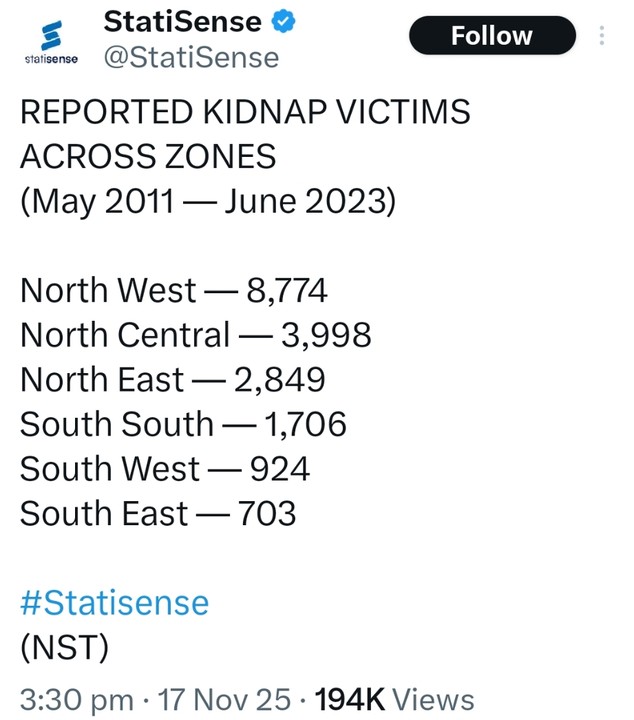
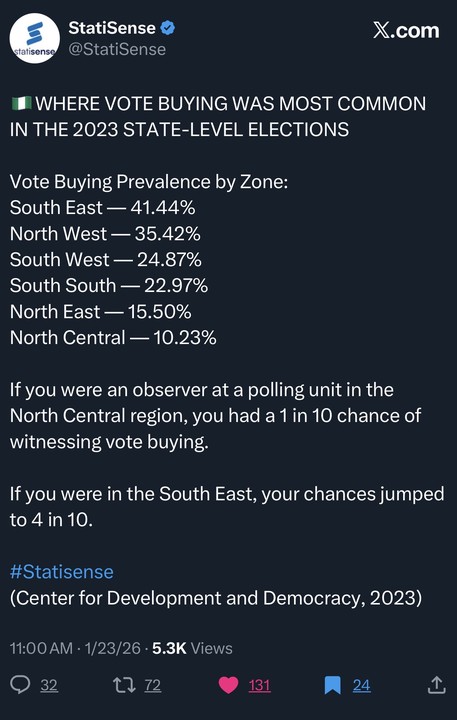
Nigeria’s South East has emerged as the safest geopolitical zone in the country over the last one month, according to newly released figures by StatiSense. The report, which analysed conflict-related fatalities across the country between January 27 and February 26, 2026, places the South East far below every other region in terms of recorded deaths.
According to the data, the North East recorded 380 fatalities within the period, followed closely by the North West with 354 deaths. The North Central zone registered 233 fatalities, while the South West and South South recorded 16 and 12 deaths respectively. The South East stood out with just eight fatalities, the lowest figure nationwide.
The findings contrast sharply with dominant public narratives that have, in recent years, portrayed the South East as one of Nigeria’s most volatile regions due to separatist agitation, sit-at-home orders, and sporadic attacks. StatiSense’s figures suggest that, at least within the period under review, the region experienced relative calm compared to other parts of the country grappling with insurgency, banditry, and communal violence.
The data has sparked widespread reactions across social and political spaces, particularly on social media. Many commentators welcomed the report as validation of what residents of the region have long argued—that insecurity in the South East has often been exaggerated or selectively amplified. Some users described the statistics as evidence that peace has gradually returned to “Ala Igbo,” while others praised recent security efforts by both federal and state authorities.
Supporters of the current administration credited President Bola Ahmed Tinubu for what they described as improved security coordination, arguing that the decline in fatalities reflects a shift in strategy compared to previous years. Others pointed specifically to state-level interventions, including actions taken by governors such as Chukwuma Soludo, to curb unrest and restore normal economic and social activities.
However, the report has not gone without criticism. Some analysts questioned why the data focused on a one-month window, arguing that a longer timeframe—such as six months or one year—would provide a more comprehensive picture of security trends. Others pointed out population differences between zones, suggesting that absolute fatality figures should be adjusted on a per-capita basis to allow for fairer comparisons between regions with vastly different population sizes.
There were also debates over methodology, with sceptics asking what categories of violence were included in the fatality count and whether underreporting might have affected figures in some regions. Despite these concerns, many agreed that the data still highlights the disproportionate scale of violence in northern Nigeria, where insurgency and banditry continue to claim hundreds of lives monthly.
Beyond statistics, the report has reignited political arguments about the roots of insecurity in Nigeria. Some commentators blamed past administrations, particularly that of former President Muhammadu Buhari, for what they described as years of neglect, ethnic bias, or ineffective security policies that allowed violence to escalate in parts of the country. Others countered that insecurity is a structural national problem that transcends any single leader or region.
For residents of the South East, the report offers cautious optimism. Markets, transport networks, and social life in many cities across the zone have shown signs of recovery after years of disruption. Traders and travellers say fear has reduced, even though sporadic incidents still occur and vigilance remains necessary.
Security experts warn, however, that short-term improvements should not lead to complacency. They stress that sustained peace will depend on consistent intelligence-led policing, economic inclusion, dialogue with local communities, and addressing broader national drivers of violence such as poverty, unemployment, and weak justice systems.
In the end, StatiSense’s findings serve as both reassurance and reminder: reassurance that parts of Nigeria previously labelled unsafe can experience relative stability, and a reminder that insecurity remains deeply uneven across the country. Whether the South East can maintain its position as the safest zone in the months ahead will depend on how effectively gains are consolidated and whether lessons from the region can be applied elsewhere.



Responses