Vote Buying and Nigeria’s Democracy: What the 2023 State-Level Election Data Reveals

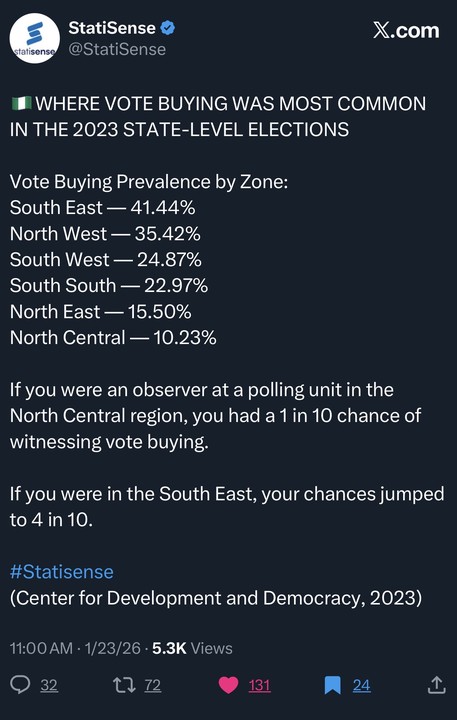
Fresh statistics on vote buying during Nigeria’s 2023 state-level elections have once again ignited heated debates across political and social spaces, highlighting a long-standing challenge confronting the country’s democratic process. Data shared by StatiSense, drawing from findings by the Centre for Development and Democracy (CDD), outlines the regions where vote buying was reportedly most prevalent, offering a snapshot of how deeply the practice has penetrated grassroots politics.
According to the figures, the South East recorded the highest prevalence of vote buying, with 41.44 per cent of observers reporting incidents at polling units. This was followed closely by the North West at 35.42 per cent. The South West ranked third with 24.87 per cent, while the South South came in at 22.97 per cent. The North East recorded 15.50 per cent, and the North Central had the lowest reported prevalence at 10.23 per cent. Interpreted simply, the data suggests that an observer stationed at a polling unit in the North Central region had roughly a one-in-ten chance of witnessing vote buying, whereas in the South East, the likelihood rose to about four in ten.
While the statistics were meant to inform and provoke reflection on electoral integrity, they quickly became fuel for partisan arguments. Supporters and critics of different political parties seized on the data to reinforce long-held narratives about the 2023 elections. Some commentators argued that the figures confirmed what they described as widespread manipulation in certain regions, particularly pointing fingers at the South East. Others dismissed the statistics outright, questioning the methodology and accusing the source of bias or political motivation.
The reactions underscore a broader issue: vote buying is no longer viewed merely as an electoral offence but has become deeply entangled with regional, ethnic, and party loyalties. For some contributors, the data was used to accuse entire regions of hypocrisy—claiming that areas loudest in condemning rigging were themselves deeply involved in electoral malpractice. For others, the statistics were interpreted as evidence that political parties invest more resources, including illicit inducements, in regions where they expect resistance, rather than in their traditional strongholds.
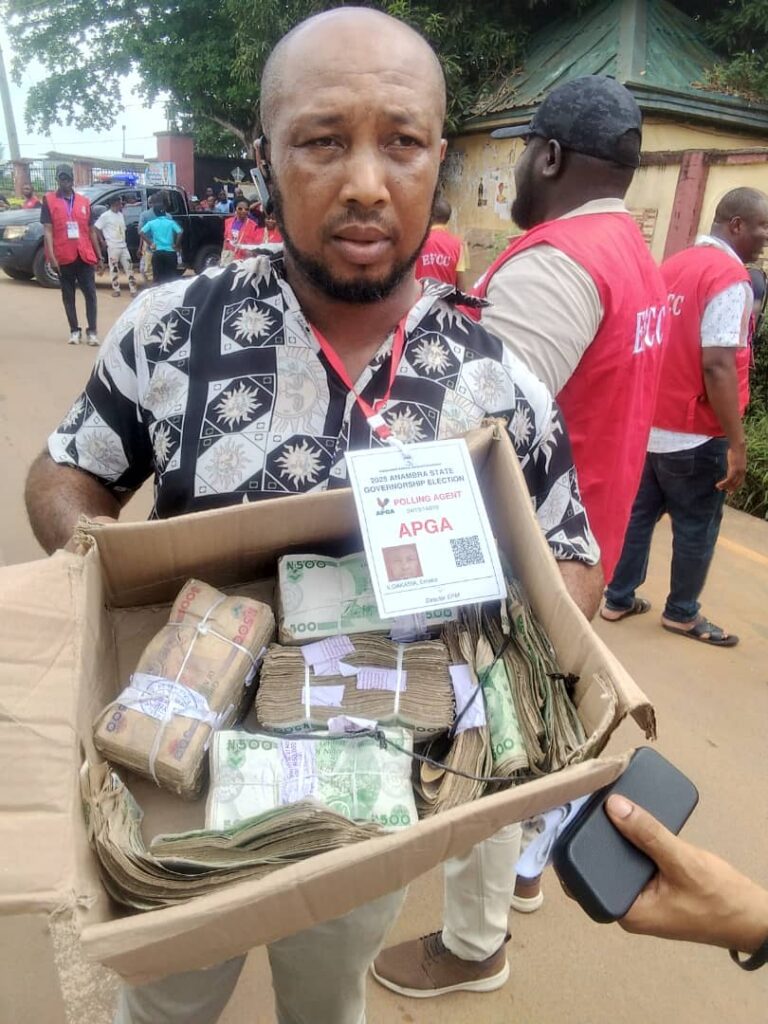
Beyond the online exchanges and political banter lies a more sobering reality. Vote buying, regardless of where it is most prevalent, erodes the very foundation of democracy. When voters exchange their ballots for cash, food items, or other inducements, elections shift from being a contest of ideas and competence to a transactional exercise driven by poverty and desperation. Several commentators, even amid sarcasm and cynicism, pointed to this underlying problem, noting that economic hardship makes citizens vulnerable to inducements and weakens resistance to corrupt practices.
Interestingly, some voices argued that vote buying does not always guarantee electoral success. They claimed that in certain polling units, voters collected money from party agents only to vote according to personal conviction. While such stories may offer momentary comfort, they do little to address the systemic damage caused by the normalization of inducements in elections. The presence of vote buying alone compromises the credibility of the process, regardless of the final outcome.
The controversy surrounding the StatiSense data also reflects declining public trust in institutions and election monitoring mechanisms. Doubts about statistics, accusations of propaganda, and outright rejection of uncomfortable findings reveal a society struggling to agree on basic facts. This lack of consensus makes reform even more difficult, as every attempt to address electoral malpractice is filtered through partisan suspicion.
As Nigeria looks ahead to future elections, including 2027, the lessons from the 2023 state-level polls are clear. Vote buying remains a nationwide problem, varying in intensity across regions but present everywhere. Addressing it will require more than naming and shaming zones or parties. It demands stronger enforcement of electoral laws, improved voter education, economic empowerment of citizens, and renewed commitment by political actors to play by the rules.
Ultimately, democracy cannot thrive where votes are treated as commodities. The debate sparked by these statistics, heated as it may be, should serve as a call to confront uncomfortable truths and work collectively toward elections that truly reflect the will of the people, not the size of campaign war chests.




Responses