Bagudu defends Tinubu’s economic reforms, says fuel subsidy removal necessary

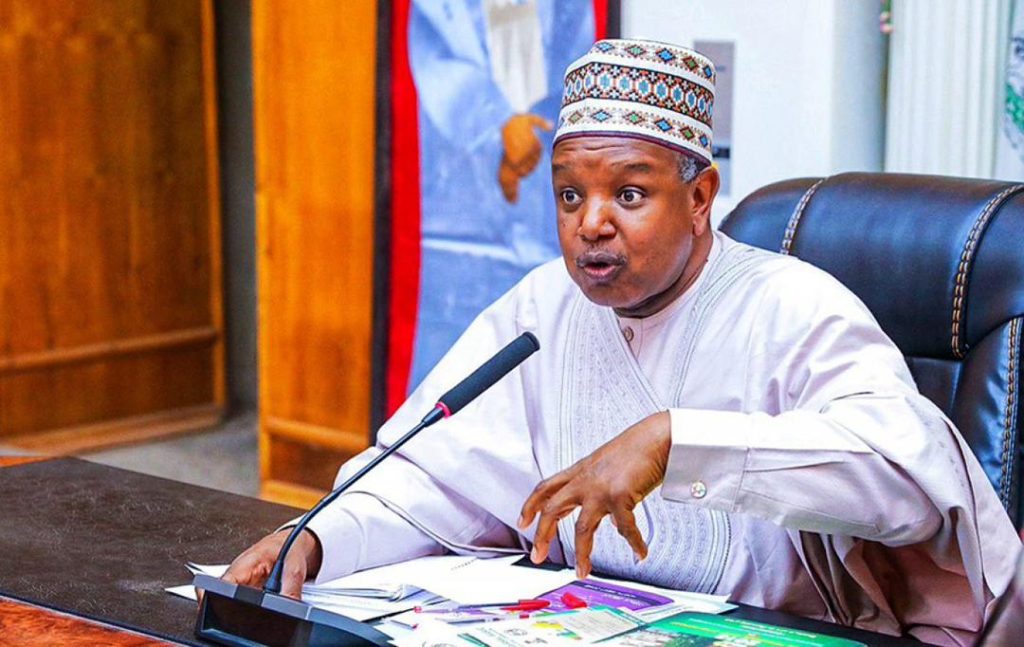
Atiku Bagudu, the Minister of Budget and Economic Planning, has come forward to support President Bola Tinubu’s economic reforms, particularly the decision to eliminate the fuel subsidy, which he describes as essential for Nigeria’s economic progress.
In an article featured in The Explainer, a weekly publication by the National Orientation Agency, Bagudu emphasized that discussions around fuel subsidies often overlook the fact that prices for diesel and kerosene have already been deregulated, leaving petrol as the relatively cheaper option.
He highlighted the need for Nigeria to transition to Compressed Natural Gas (CNG) as a more economical energy alternative, especially in the transportation sector. “While the President has addressed the fuel subsidy issue and the discussions surrounding CNG, this shift may lead to short-term disruptions for vulnerable populations. However, with effective measures, we can foster a competitive energy sector that promotes growth,” Bagudu remarked.
Bagudu noted that the Tinubu administration is proactively addressing these challenges through its Renewed Hope Agenda, which incorporates social intervention programs designed to mitigate the effects of the economic reforms. He stated that the president’s approach aims to confront difficult realities while laying the groundwork for sustainable growth.
He compared Nigeria’s economic size to other nations, pointing out that the federal budget stands at around $20 billion. In contrast, countries like Indonesia and Brazil have budgets of $213 billion and $750 billion, respectively. “This disparity highlights our inability to meet economic goals if we maintain our current trajectory. We must increase our revenue,” he explained.
Bagudu further illustrated this point by discussing monthly federal allocation meetings, where less than $2 billion is distributed among the three tiers of government. This totals only $24 billion annually, which puts significant pressure on state governments reliant on these funds.
He underscored Tinubu’s vision to elevate Nigeria to a $1 trillion economy, emphasizing the necessity of making difficult choices. “Managing our foreign exchange is critical. Given our limited foreign currency reserves, it’s crucial for the Central Bank to have operational independence. The President endorses this approach, inspired by other nations facing similar issues. A market-driven system will attract more revenue and stabilize the exchange rate,” he added.
Bagudu also praised the President’s initiative to empower youth through a training program aimed at 3 million individuals in fields such as automation, artificial intelligence, and robotics. He highlighted the support for agriculture, small and medium enterprises, and microcredit schemes to stimulate local economic activity.
“The recent $900 million oversubscription of our dollar bond indicates increasing confidence in our economy, and rating agencies have provided positive assessments. On the international stage, we receive recognition for our reforms, with countries like Saudi Arabia commending the President’s focus on economic development,” Bagudu concluded.


Responses