Customs Seizes Five Trucks of Smuggled Rice Worth Over N919 Million at Seme Border

In yet another bold move against smuggling, the Nigeria Customs Service (NCS), Seme Area Command, has intercepted five trucks laden with contraband goods — including thousands of bags of foreign rice — with an estimated duty-paid value of nearly N920 million.
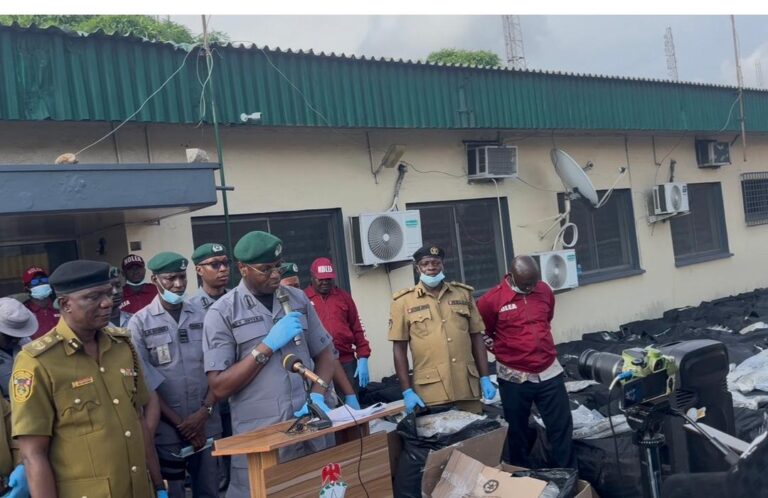
The interception, which took place between July 1 and July 19, 2025, was disclosed by the Customs Area Controller, Dr. Benedict Oramalugo, during a media briefing held at the Joint Border Post complex in Seme. According to Dr. Oramalugo, the operation was a result of strategic intelligence gathering and swift response by the Command’s operatives along the busy Lagos-Abidjan corridor — a known hotspot for illicit trade.
“These seizures are the result of credible intelligence and vigilant enforcement by our officers,” he stated. “The intercepted trucks were loaded with 2,800 bags of 50kg foreign parboiled rice and about 250 bales of used clothing.”
While these commodities may appear ordinary to the unsuspecting public, their mode of entry and the scale of their movement raised red flags. Importation of rice through land borders remains officially banned in Nigeria, a policy put in place by the Federal Government to protect local rice producers and strengthen the nation’s agricultural sector.
The five intercepted trucks, now in Customs custody, collectively carried goods worth a duty-paid value of N919,500,626, marking one of the largest single rice seizure operations by the Seme Command this year.
The discovery of the smuggled rice and clothing wasn’t the only success recorded by the command. Dr. Oramalugo revealed that between May 14 and June 30, 2025, the Command had already seized a variety of prohibited goods, including additional bags of foreign rice, illegal drugs, and other restricted imports.
Within that timeframe, Customs officers confiscated a total of 4,119 bags of smuggled rice. Other items recovered included cannabis sativa, large quantities of sugar and flour, cartons of tomato ketchup, a boat fitted with an engine, as well as multiple bales of second-hand clothing and used shoes.
The cumulative duty-paid value for all seizures between mid-May and end of June reached an impressive N1.26 billion — a figure that not only reflects the scale of smuggling in the region but also the effectiveness of recent anti-smuggling measures.
Dr. Oramalugo credited these successes to the hard work, resilience, and discipline of his officers, backed by support from other security forces, including the Nigerian military. “Their vigilance and commitment have helped ensure that Nigeria’s economic policies are upheld at our borders,” he said.
The Customs boss didn’t shy away from addressing the broader implications of these illegal imports. He emphasized that while Nigeria remains the leading producer of rice in Africa, producing over 8 million metric tonnes annually, the country still battles low patronage of locally milled rice due to the influx of smuggled alternatives.
“Smuggling undermines our agricultural development efforts,” he said. “It hurts local farmers and rice millers who are trying to compete against unfair, unregulated imports. This is why the ban on rice imports via land borders must be enforced without compromise.”
Despite Nigeria’s efforts to boost self-sufficiency in food production, local producers continue to struggle with underutilized capacity, largely due to illegal rice flooding in from neighboring countries. The intercepted rice, much of it parboiled and packaged for resale, competes directly with homegrown alternatives, distorting market prices and discouraging investment in domestic farming.
Dr. Oramalugo urged citizens and stakeholders to understand the purpose behind these trade restrictions. “It’s not just about enforcement. It’s about protecting jobs, encouraging investment in local agriculture, and ensuring food security for all Nigerians,” he said.
Among the seized contraband was a quantity of cannabis sativa, the type often trafficked across West Africa and linked to various forms of organized crime. Dr. Oramalugo confirmed that the seized narcotics would be transferred to the appropriate drug enforcement agencies for further investigation and prosecution.
“This is not just an economic issue — it’s also a matter of national security,” he noted.
Despite the ongoing battle against smugglers, the Seme Command has continued to generate strong revenue. Between May and June 2025, the command collected N1.59 billion in official revenue. According to Dr. Oramalugo, this performance was driven by tighter anti-leakage controls and a renewed focus on transparency and compliance.
“We ensured every legitimate kobo owed to the Federal Government was collected, with utmost integrity,” he said.
In addition to revenue collection, the Seme Command played a key role in facilitating Nigeria’s export activities. During the same two-month period, the command cleared 1,837 export trucks carrying more than 116,700 metric tonnes of goods. The Free on Board (FOB) value of these exports was N22.37 billion, with NESS (Nigerian Export Supervision Scheme) fees totaling over N111 million.
Dr. Oramalugo also acknowledged the support of the Comptroller-General of Customs and the national management team for strengthening the operational capacity of border commands. He highlighted the recent allocation of 12 patrol vehicles to the Seme Command as a key development that has enhanced surveillance and response times.
“The difference is clear. The seizures you are seeing today are the direct result of improved mobility, better coordination, and stronger presence at strategic border points,” he noted.
The Customs boss concluded with a firm message to smugglers and their collaborators: the Seme Command will not compromise in the enforcement of Nigeria’s trade and fiscal policies.
“Our borders are not open for smuggling. Anyone caught attempting to undermine our economy will face the full force of the law,” he warned.
As Nigeria continues to push for economic diversification and self-reliance, the work of the Nigeria Customs Service — particularly at high-risk points like the Seme border — remains vital. The recent seizures stand as a testament to the agency’s commitment to protecting local industries and securing the nation’s trade ecosystem.





Responses