Germany Train Tragedy: Three Killed, Dozens Injured After Derailment Near Riedlingen

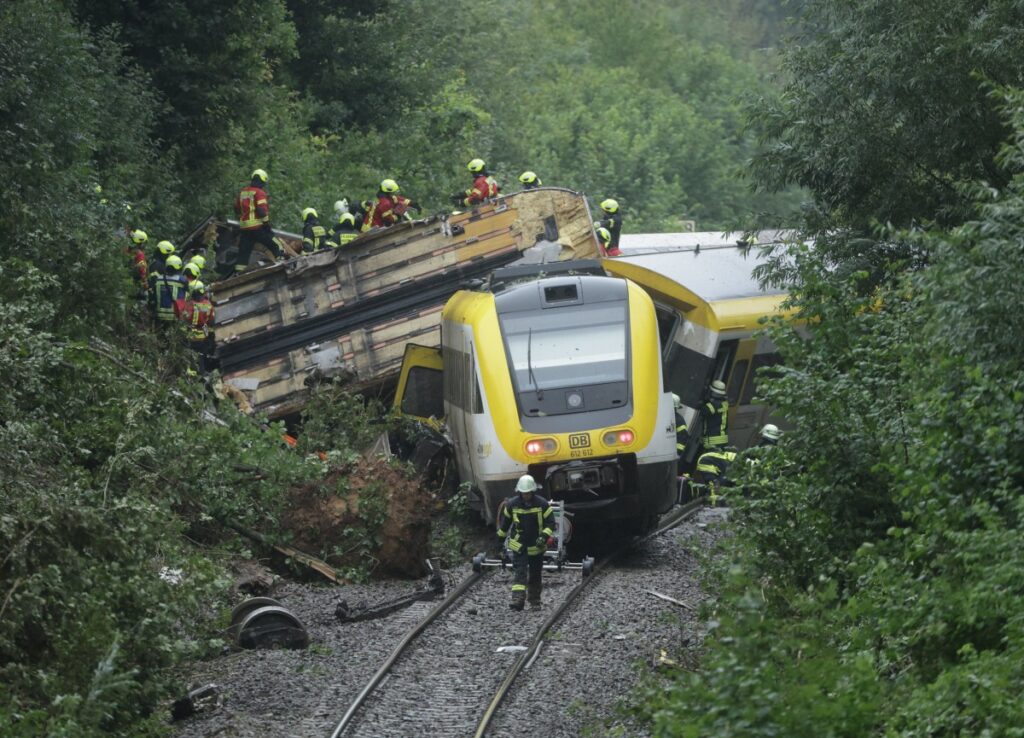
Tragedy struck southwestern Germany on Sunday evening when a regional passenger train derailed in a wooded area near the town of Riedlingen, Baden-Wuerttemberg, leaving three people dead and many others injured. The accident occurred around 6:10 p.m. local time, as the train made its way from Sigmaringen to Ulm.
According to police, approximately 100 people were onboard the train at the time of the derailment. Initial reports had indicated four fatalities, but authorities later clarified that three individuals lost their lives. Several others were injured, though officials have yet to provide an exact number or confirm the severity of those injuries. However, Germany’s widely read tabloid newspaper, Bild, cited emergency responders saying as many as 50 people may have been hurt in the incident.
German rail operator Deutsche Bahn confirmed the casualties and stated that two train carriages had gone off the tracks for reasons that are still under investigation. The derailment prompted an immediate suspension of rail traffic across a 40-kilometer stretch of the route while emergency crews rushed to the scene. Images shared from the area showed rescue workers, firefighters, and emergency personnel navigating the heavily wooded terrain where train cars lay tipped over on their sides.
Rescue helicopters were deployed to airlift the seriously injured to nearby hospitals, and medical teams from local facilities were mobilized to provide emergency care. First responders described the scene as chaotic but coordinated, with every effort made to quickly extract passengers and stabilize the wounded.
Authorities have not yet confirmed what caused the train to derail, but early speculation points to a possible landslide in the area. Meteorological services reported intense storms and heavy rainfall across parts of Baden-Wuerttemberg earlier in the day. German media outlets, including public broadcaster SWR, cited this severe weather as a potential factor contributing to the disaster.
German Chancellor Friedrich Merz expressed his deep sorrow over the tragic loss of life. In a statement posted to social media, the Chancellor extended his condolences to the families of the deceased and said he had spoken with both the interior and transport ministers to ensure that emergency personnel receive all the support they need. He also emphasized the importance of quickly uncovering the cause of the derailment to prevent similar incidents in the future.
The accident comes amid growing criticism of Germany’s rail infrastructure, which many passengers describe as increasingly unreliable. Frequent delays, aging systems, and technical faults have plagued Deutsche Bahn for years. Although Germany has one of the most extensive rail networks in Europe, calls for urgent modernization have intensified. Critics argue that despite the country’s economic strength, its transport infrastructure lags behind that of other developed nations.
The German government has acknowledged these challenges and pledged to invest hundreds of billions of euros over the next decade to overhaul its railway system. Plans include the replacement of outdated tracks, upgrading signaling technology, and expanding maintenance capacity. However, progress has been slow, and public frustration continues to mount.
Sunday’s derailment is not the first deadly rail accident in recent German history. In June 2022, four people were killed and dozens injured when a train derailed near the Bavarian Alpine resort of Garmisch-Partenkirchen. That accident, like the current one, raised questions about the safety of regional trains and the urgency of infrastructure improvements.
Germany’s worst rail disaster occurred in 1998 when a high-speed ICE train derailed in the town of Eschede, Lower Saxony. That horrific incident claimed 101 lives and remains one of the most catastrophic train accidents in European history. The tragedy led to widespread reforms in rail safety protocols, but recent accidents suggest that further work is needed to maintain the integrity and safety of the network.
As investigators begin their work to uncover the precise cause of Sunday’s derailment, questions are already being asked about whether this tragedy could have been prevented. Was the weather to blame, or did infrastructure failures contribute to the crash? Could early warning systems have mitigated the danger? These are the issues that federal and regional authorities, as well as Deutsche Bahn, must now address.
Meanwhile, the people affected by the incident are dealing with the immediate trauma of what happened. Survivors are receiving medical care and psychological support, while families of the deceased have been notified and are being supported by crisis counselors.
For now, the area around Riedlingen remains cordoned off as investigators comb through the debris and try to reconstruct the sequence of events that led to this devastating derailment. Emergency crews are working carefully to stabilize the scene and retrieve the last of the derailed carriages.
The German public, still reeling from the shock, awaits answers. For the families who lost loved ones and those recovering in hospitals, those answers cannot come soon enough. But for a country known for precision and efficiency, this tragic accident serves as a sobering reminder that no system is immune to failure—and that the cost of inaction on infrastructure can be devastating.




Responses