Maryam Sanda’s Pardon and Tinubu’s Crisis of Clemency — Farooq Kperogi Criticizes Presidential Mercy

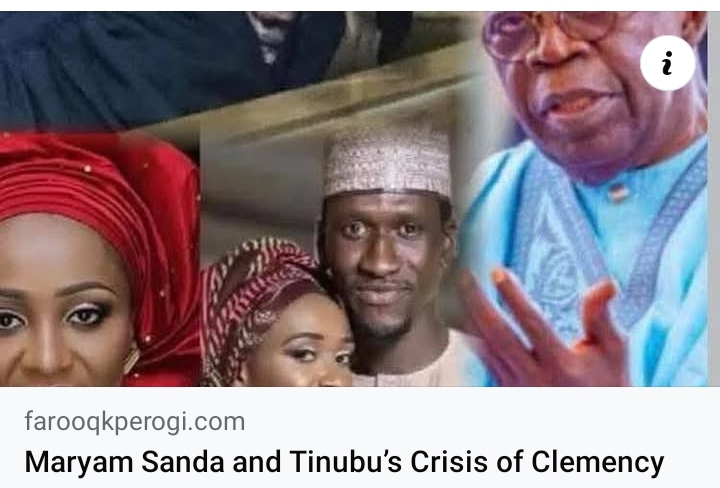
Public outrage has continued to trail the recent list of 175 convicts approved for presidential pardon by President Bola Ahmed Tinubu, as renowned columnist and political commentator, Farooq A. Kperogi, sharply condemned what he described as an abuse of constitutional power.
In his latest Saturday Tribune column, titled “Maryam Sanda and Tinubu’s Crisis of Clemency,” Kperogi faulted the President’s decision to grant clemency to individuals convicted of grave crimes — including murderers and drug traffickers. The most controversial name on the list was Maryam Sanda, who was sentenced to death in 2020 for the brutal killing of her husband, Bilyaminu Bello, the son of a former PDP chairman, Bello Haliru Mohammed.
Kperogi acknowledged that the Nigerian Constitution empowers the President to grant pardons under Section 175, but he argued that such powers must be exercised with moral restraint. “Constitutional rights are not moral shields,” he wrote. “Mercy must ennoble justice, not mock it.”
The federal government, reacting to the backlash, clarified through Attorney-General Lateef Fagbemi (SAN) that no inmate has yet been released, saying the process remains “at the final administrative stage.” However, Kperogi noted that the clarification only highlights the opportunity for Tinubu to correct the moral and political damage before the clemency takes full effect.
The journalist criticized the “theatrics” surrounding Sanda’s proposed pardon, particularly the press conference where Ahmed Bello Isa, the biological father of the late Bilyaminu Bello — who was reportedly absent from his son’s life — appeared before cameras to justify the pardon. Isa claimed he sought mercy for Sanda so their grandchildren could grow up with their mother. Kperogi described the event as “a choreographed display of mawkish sentimentality,” allegedly engineered by Sanda’s influential family to manipulate public emotions.
He noted that Bello’s adoptive family, who had cared for and buried him, reacted with deep pain, calling the pardon “the worst injustice any family could face.” Their statement read, “To have Maryam Sanda walk free as if she merely squashed an ant is a devastating insult to justice.”
Kperogi further questioned the criteria for determining “good conduct” among the pardoned prisoners, asking how a convicted murderer like Sanda, sentenced just five years ago, could have demonstrated sufficient repentance or rehabilitation to merit clemency. “Where is the proof of remorse? Where is the evidence of reform?” he asked.
He warned that the inclusion of violent offenders undermines the integrity of Nigeria’s justice system, demoralizes law enforcement officers, and tells victims that “their pain can be erased by elite connections.” He also pointed out the contradiction of granting pardons to convicted drug traffickers while the government simultaneously promotes a “war on drugs” campaign.
Kperogi stressed that while the prerogative of mercy is legal, legality does not always equate to morality. He urged Tinubu to use his power to free wrongly convicted individuals, prisoners of conscience, or those serving long terms for minor, non-violent offenses — not the rich and powerful with political ties.
“Clemency must not reward crime,” he wrote. “A pardon should come from a transparent process involving victims’ families, prosecutors, and mental-health professionals — not political patronage.”
He called on the President to halt the current process, remove controversial names like Sanda’s, and reform the system to include civil society and victims’ advocacy groups in future clemency reviews.
According to Kperogi, granting freedom to Sanda and other violent offenders would send a dangerous message: that wealth and influence can override justice. “Every pardon sends a message,” he warned. “This one tells Nigerians that if you are from a powerful family, you can murder and walk away free.”
He concluded by urging Tinubu to act with conscience: “True mercy cannot be traded for lineage or politics. Mercy divorced from morality is corruption. For once, let power bow before principle.”




Responses