Notorious Bandit Leader Fidelis Guyama Arrested in Major Security Breakthrough Across Taraba–Benue Axis


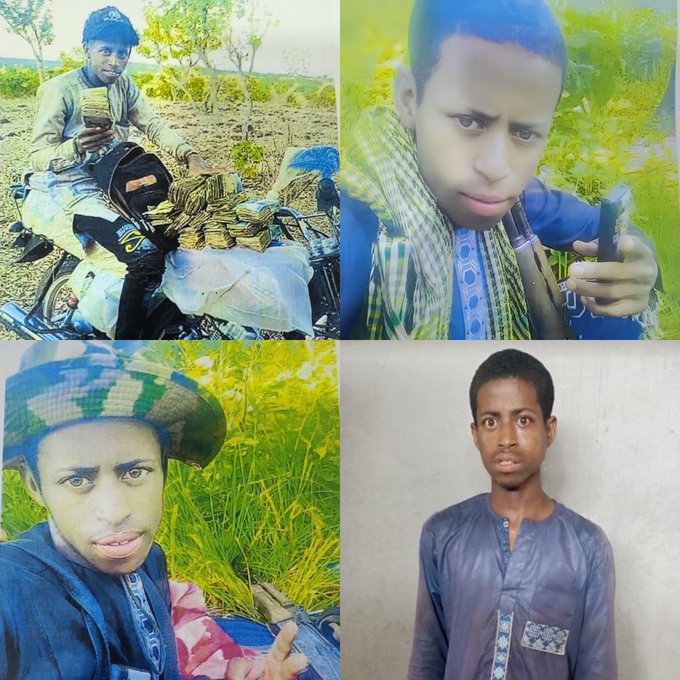
Nigeria’s ongoing battle against banditry and violent crime recorded a significant breakthrough with the arrest of Fidelis Guyama, a notorious and long-wanted bandit leader accused of masterminding kidnappings, armed robbery, and multiple killings across Taraba, Benue, and Plateau states. The arrest has been widely described as a major win for security forces operating in the volatile Middle Belt region, where rural communities have endured years of fear and instability.
According to security reports, Guyama was apprehended on December 21, 2025, during an intelligence-driven operation carried out by troops of the Forward Operating Base (FOB) Wukari, under the 6 Brigade of the Nigerian Army, Sector 3 of Operation Whirl Stroke. The operation took place in Vaase community, Ukum Local Government Area of Benue State, following weeks of surveillance and actionable intelligence tracking his movements.
Fidelis Guyama had been on the wanted list of security agencies in both Taraba and Benue States due to his alleged leadership role in several high-profile criminal attacks. Authorities say he coordinated kidnapping rings, ambushes on highways, and violent raids on rural settlements, leaving many families traumatized and communities displaced. His operations reportedly stretched across state boundaries, exploiting porous rural routes and forest hideouts that have long posed challenges for law enforcement.
Security sources further revealed that Guyama often carried out his crimes under the guise of Fulani herdsmen, a tactic believed to have fueled ethnic suspicion and communal tensions in affected areas. Investigators say this strategy complicated community relations and diverted attention from the real perpetrators, worsening mistrust between farmers and pastoral communities already strained by competition over land and resources.
The arrested bandit leader is also said to be linked to another notorious criminal figure known as “Dogo,” who has been responsible for repeated attacks along the Kente–Wukari road, a critical route for local trade and movement. Residents of the area have for years complained about persistent ambushes, kidnappings, and robberies on that corridor, calling repeatedly for stronger military presence.
Reactions to Guyama’s arrest have been swift and deeply polarized, reflecting Nigeria’s broader social and political fault lines. While many Nigerians praised the military for demonstrating that bandits can be captured alive through coordinated intelligence and decisive action, others used the incident to push ethnic or religious narratives, sparking heated debates online. Some commentators framed the arrest in religious terms, while others strongly rejected such interpretations, insisting that criminality should never be conflated with faith or ethnicity.
Several voices emphasized that Guyama’s capture reinforces an important truth: banditry in Nigeria is driven by criminal networks, not religion or ethnic identity. Analysts argue that focusing on the criminal behavior itself—rather than assigning collective blame—remains essential for lasting peace and effective counter-terrorism efforts. They warned that careless generalizations only deepen divisions and undermine trust between communities and security agencies.
Beyond the online arguments, many Nigerians expressed hope that the arrest signals a renewed seriousness in tackling insecurity. Residents of Taraba, Benue, and Plateau states have long accused politics, poor coordination, and lack of sustained operations of weakening the fight against armed groups. Guyama’s capture, achieved without a large-scale clash, has been cited as proof that intelligence-led operations can yield results when properly executed.
However, citizens and civil society groups are now calling for transparency and accountability. They insist that arrest alone is not enough, urging authorities to ensure proper investigation, prosecution, and justice for victims. Many want Guyama’s interrogation to expose his networks, financiers, collaborators, and supply routes, so that his arrest does not become another isolated success in a long war.
As Nigeria continues to confront insecurity on multiple fronts, the capture of Fidelis Guyama stands as both a symbolic and practical milestone. It offers reassurance that even the most elusive criminals can be brought to justice, while also underscoring the urgent need for sustained, unbiased, and professional security operations that prioritize national unity over divisive narratives.




Responses