Peter Obi Sparks Online Debate After Appearing in ‘Village Boy Movement’ T-Shirt

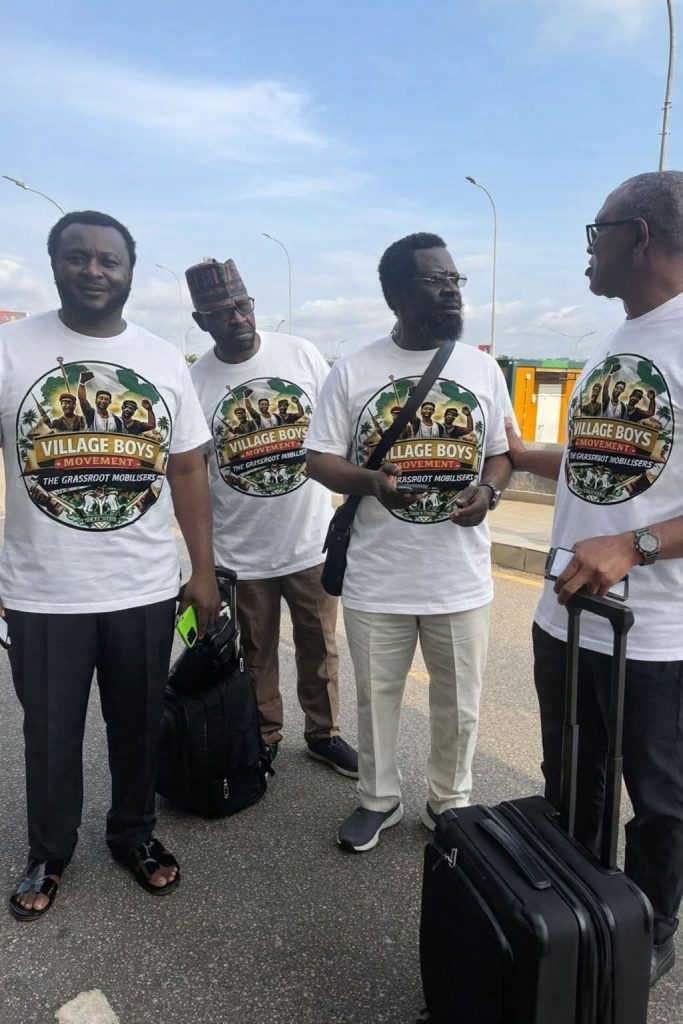
Former presidential candidate Peter Obi has again found himself at the centre of intense public debate after photographs emerged online showing him wearing a T-shirt branded with the slogan “Village Boy Movement.” The images, which circulated widely on social media platforms on Tuesday, showed Obi in the company of lawyer and public commentator Dele Farotimi and other supporters believed to be linked to the Obidient political movement.
The appearance quickly generated mixed reactions, with supporters interpreting the slogan as a symbolic statement aimed at celebrating grassroots identity and rejecting what they describe as elitist political branding. Critics, however, accused the former Anambra State governor of lacking originality, arguing that the slogan was a direct response to the ruling party’s “City Boy” narrative popularised during recent political campaigns.
Although Obi has not officially commented on the meaning or intent behind the “Village Boy Movement” T-shirt, many of his supporters online framed it as a deliberate attempt to reclaim the idea of rural Nigeria and emphasise the importance of inclusive development. According to them, the message resonates with millions of Nigerians living outside major urban centres who feel marginalised by governance that prioritises city-based infrastructure and political elites.
On the other hand, detractors dismissed the move as political gimmickry, with some describing it as a poorly thought-out publicity stunt. Several commentators argued that associating leadership with “village” symbolism risks reinforcing negative stereotypes about underdevelopment rather than offering a clear policy alternative. Others accused Obi of engaging more in branding battles than articulating concrete strategies ahead of the 2027 general elections.
The development also reignited broader conversations about political messaging in Nigeria, where slogans and labels often take on lives of their own. In recent years, campaign branding has increasingly shifted from policy-heavy discourse to symbolic messaging designed to energise supporters and dominate online conversations. Analysts note that while such tactics can mobilise grassroots enthusiasm, they also expose politicians to ridicule and polarisation.
Supporters within the wider Obidient movement insist that the backlash is exaggerated, arguing that the T-shirt should be seen as a cultural statement rather than a literal endorsement of underdevelopment. They point out that Obi’s political record, particularly in fiscal management and education investment during his tenure as governor, contradicts claims that he represents “retrogression.”
Meanwhile, critics aligned with the ruling party and its supporters used the moment to reinforce their narrative that Nigeria’s future lies in rapid urbanisation and modern city-driven growth. Some commentators went as far as describing the imagery as evidence that the opposition lacks a coherent vision beyond reactive slogans.
As reactions continue to pour in, the episode highlights how even seemingly minor political gestures can spark nationwide debate in Nigeria’s highly charged political environment. Whether the “Village Boy Movement” evolves into a sustained political message or fades as a social media moment remains to be seen. What is clear, however, is that Peter Obi’s public appearances continue to attract scrutiny, underscoring his enduring relevance in opposition politics and the broader national conversation ahead of future elections.



Responses