Omokri Hails Tinubu’s Economic and Security Progress, Faces Fierce Rebuttal from Mike Arnold

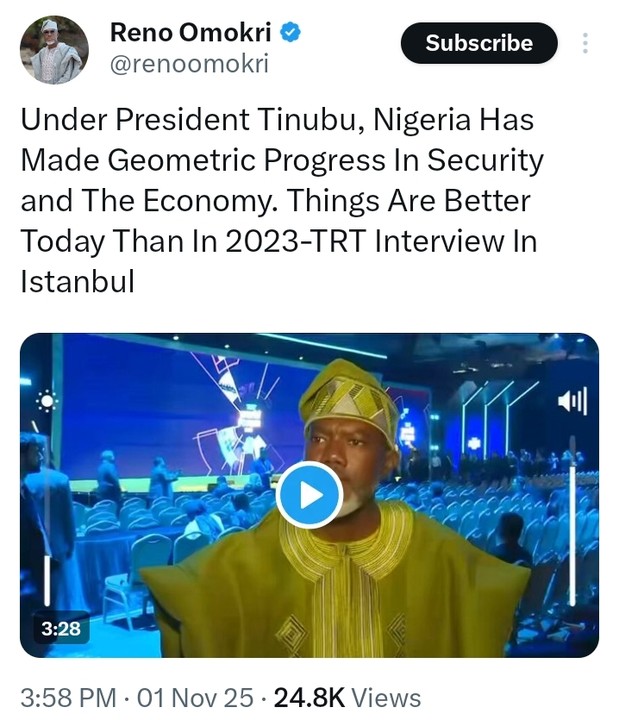
A heated online exchange erupted on Friday between Nigerian political commentator Reno Omokri and U.S.-based analyst Mike Arnold, after Omokri claimed that Nigeria’s economy and security have “improved geometrically” under President Bola Ahmed Tinubu.
Speaking in an interview with TRT World in Istanbul, Omokri asserted that the administration had made “notable progress” since 2023, citing better macroeconomic indicators and improved national stability.
“Under President Tinubu, Nigeria has made geometric progress in security and the economy. Things are better today than in 2023,” Omokri said during the interview, which he later shared on his verified X (Twitter) account.
The former aide to ex-President Goodluck Jonathan praised Tinubu’s policies as “structural and pragmatic,” claiming they were beginning to yield visible results both locally and internationally.
However, his remarks sparked a wave of criticism across social media, with many accusing him of political opportunism and hypocrisy — given his history of fierce criticism toward previous administrations.
Mike Arnold Fires Back: “Look, His Lips Are Moving!”
Within hours of Omokri’s post, U.S.-based social commentator Mike Arnold issued a scathing response on his X handle, dismissing Omokri’s claims as disingenuous and politically motivated.
“Look, his lips are moving! And so were President Trump’s yesterday, when he called out the genocide Omokri called a ‘hoax’ and declared Nigeria CPS (as a start)!” Arnold wrote sarcastically.
He accused Omokri of downplaying widespread violence and human rights abuses in Nigeria while attempting to “protect the political establishment.”
“It’s hard to sustain an economy built on mass slaughter, mass displacement, and corruption,” Arnold continued. “If you truly cared about the economy and not your pocketbook, you’d sing a different tune.”
Arnold’s comments came just a day after former U.S. President Donald Trump allegedly warned about violence against Christians in Nigeria, adding fuel to the already charged political discourse online.
Public Reactions: Anger, Division, and Defensiveness
Omokri’s praise for the Tinubu administration — and Arnold’s sharp retort — ignited a storm of reactions on X, and other social platforms.
Many users accused Omokri of being an “any government in power” loyalist, willing to shift allegiance for personal gain. One poster described him as “a soulless puppet… a master of deception who spins lies with a smile while selling out truth for a paycheck.”
Another wrote, “No APC laptop boys even defend Reno again. See how shameless he has become just to eat. Very soon, he’ll tire like the others who defended Buhari for eight years.”
Others took aim at his alleged silence in responding to recent international criticisms, especially from figures like Mike Arnold and opposition activist Omoyele Sowore. “He can’t respond because his U.S. citizenship card is on the line,” one user claimed.
Some, however, defended Omokri’s position, insisting that economic recovery cannot happen overnight. “Reno always comes with facts,” one supporter argued. “No Nigerian government can satisfy everyone in just one year.”
Still, a significant number of commenters sided with Arnold, describing him as “the voice of the voiceless.” “When Reno is lying, his lips are moving,” one user quoted Arnold’s viral post, calling it the “quote of the year.”
Political Undercurrents and Broader Implications
The Omokri-Arnold confrontation reflects deeper divisions among Nigerians at home and abroad regarding Tinubu’s performance and the country’s trajectory.
While Omokri emphasizes policy-driven optimism, critics point to worsening insecurity, rising kidnappings, and the growing humanitarian crisis across several northern states.
“Actually, nothing has improved,” one commenter said. “Kidnapping is on the rise.” Others highlighted continued religious violence and alleged government indifference toward attacks on Christian communities.
Some analysts also suggested that the debate exposes Nigeria’s polarized information space, where political loyalty often shapes narratives more than facts.
“Every time a government official or influencer praises progress, it feels disconnected from people’s daily realities,” said one social media observer. “Most Nigerians are still struggling with inflation, unemployment, and insecurity.”
A War of Words with Global Attention
As reactions continue to unfold, the Omokri-Arnold exchange underscores how social media has become the new battleground for shaping Nigeria’s global image.
While Omokri insists that the country is on a path to recovery, Arnold and other critics warn that without confronting corruption and human rights violations, economic stability will remain elusive.
For now, both men remain defiant — Omokri promoting “measured progress,” and Arnold calling for “unfiltered truth.”
In a country where every political statement quickly becomes a national debate, one thing is clear: the war of words between both men is as symbolic as it is revealing — exposing the growing tension between perception, propaganda, and the lived reality of Nigerians today.



Responses