ECOWAS Announces Immediate Deployment of Regional Standby Force to Benin Republic

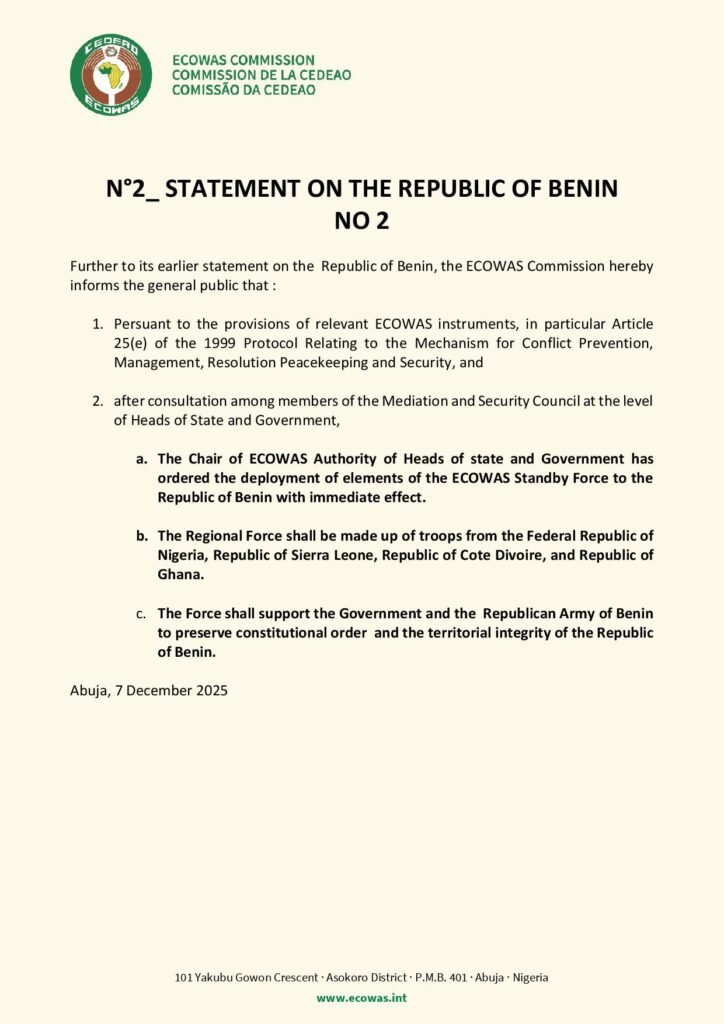
The Economic Community of West African States (ECOWAS) has ordered the swift deployment of elements of its Standby Force to the Republic of Benin following rising concerns about stability and constitutional order in the country. The directive was issued on 7 December 2025 after high-level consultations among heads of state and members of the ECOWAS Mediation and Security Council, marking one of the bloc’s fastest responses to a political crisis in recent years.
In an official statement released from its Abuja headquarters, ECOWAS emphasized that the decision was taken “pursuant to the provisions of relevant ECOWAS instruments,” notably Article 25(e) of the 1999 Protocol on the Mechanism for Conflict Prevention, Management, Resolution, Peacekeeping, and Security. The protocol grants the regional body the authority to intervene in member states facing threats to constitutional governance or territorial integrity.
According to the communiqué, the Chair of the ECOWAS Authority of Heads of State and Government authorized the immediate deployment of troops drawn from four member states: Nigeria, Sierra Leone, Côte d’Ivoire, and Ghana. Collectively, these contingents will form the regional intervention mission tasked with supporting Benin’s government and the national army in safeguarding the country’s democratic institutions.
The statement stressed that the objective of the deployment is not occupation but stabilization. ECOWAS said the force is mandated to “support the Government and the Republican Army of Benin to preserve constitutional order and the territorial integrity of the Republic of Benin.” Although the statement did not explicitly confirm the scale of the attempted coup or the depth of instability, it indicated that the region’s leaders consider the situation serious enough to warrant external military backing.
The move has generated intense reactions across West Africa, particularly in Nigeria, whose military constitutes the largest component of the ECOWAS Standby Force. Some observers applauded the decision, arguing that rapid intervention helps prevent small political ruptures from escalating into full-blown regional crises. Supporters of the move insist that ECOWAS must remain firm in stopping unconstitutional changes of government, especially amid the rising wave of coups that has swept parts of the Sahel since 2020.
However, the announcement also sparked criticism and skepticism. Many questioned why ECOWAS can act swiftly in Benin while insecurity continues to claim lives within several member states, especially Nigeria. Critics argue that banditry, terrorism, and communal violence have not received comparable urgency from regional leaders, who appear more eager to intervene in political crises than to address chronic human insecurity.
Others raised geopolitical concerns, alleging that ECOWAS’s recent posture increasingly aligns with the strategic interests of former colonial powers or Western partners seeking to maintain influence in the region. Some expressed fear that military intervention, even if well-intentioned, could escalate into a prolonged conflict or deepen public resentment toward regional institutions.
Despite the divided opinions, ECOWAS maintains that preserving democratic rule remains its priority. The bloc has consistently condemned military takeovers in Mali, Burkina Faso, Guinea, and Niger, though with mixed success. Benin, which has long been regarded as one of West Africa’s more stable democracies, now finds itself at the center of the region’s latest test of collective security.
As the deployment begins, all eyes will be on how effectively ECOWAS forces coordinate with Benin’s government and whether the intervention will stabilize the situation without triggering broader tensions. What remains clear is that the regional body intends to send a message: unconstitutional power grabs will not be tolerated, and the defense of democratic order is now a matter of collective regional responsibility.





Responses