Ghost Town in Kwara: Residents Flee Omugo Community as Insecurity Forces Mass Exodus

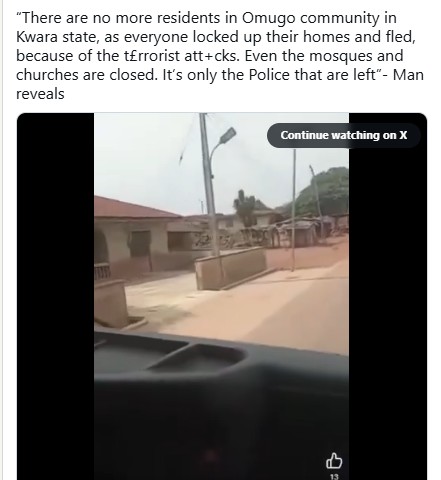
A growing wave of insecurity has forced residents of Omugo community in Kwara State to flee en masse, transforming what was once a lively settlement into a near-deserted area. According to eyewitness accounts, families have locked up their homes and escaped to safer locations following repeated attacks believed to be carried out by armed groups.
The situation, described by locals as dire and unprecedented, has reportedly led to the complete shutdown of social and religious life within the community. Mosques and churches have been closed, businesses abandoned, and daily activities halted. A resident who spoke on the development painted a grim picture, stating that “there are no more residents left,” with only security personnel remaining behind.
The exodus underscores the deepening security crisis affecting parts of Nigeria, where rural communities are increasingly vulnerable to violent attacks. In Omugo, fear appears to have reached a tipping point, compelling entire families to abandon their homes rather than risk further casualties.
Observers note that such mass displacement is more commonly associated with natural disasters or large-scale armed conflicts. However, in this case, the driving force is insecurity—an issue that has persisted across several regions of the country for years. The scale of the evacuation highlights the erosion of confidence among residents in their ability to remain safe within their own communities.
While authorities have not yet released a detailed official statement specifically addressing the Omugo situation, the broader challenge of insecurity remains a central concern for both state and federal governments. President Bola Ahmed Tinubu has previously pledged to tackle security challenges nationwide, though many citizens continue to express frustration over the pace and effectiveness of these efforts.
Public reaction to the incident has been intense and, at times, emotional. Some Nigerians have expressed sympathy for the displaced residents, describing the situation as tragic and unacceptable. Others have used the opportunity to criticize the government, arguing that the inability to protect rural communities reflects deeper systemic failures.
There are also growing concerns about the long-term implications of such displacements. When communities are abandoned, farmlands are left untended, local economies collapse, and social structures disintegrate. In some cases, displaced persons struggle to rebuild their lives even after the immediate threat subsides.
Security analysts warn that the continued spread of violence into previously stable areas could worsen internal displacement across the country. They emphasize the need for proactive measures, including improved intelligence gathering, stronger local security presence, and community engagement to prevent attacks before they occur.
At the same time, some voices have urged caution against politicizing the crisis, noting that insecurity is a complex issue that requires coordinated action at multiple levels of government. Nonetheless, the frustration among citizens remains palpable, particularly in communities that feel neglected or unprotected.
For the people of Omugo, the immediate concern is survival. Many have sought refuge in neighboring towns or urban centers, where they hope to find safety and support. However, displacement comes with its own challenges, including overcrowding, limited resources, and uncertainty about the future.
The deserted state of the community serves as a stark reminder of the human cost of insecurity. Homes once filled with life now stand locked and silent, while the absence of residents reflects the fear that has taken hold.
As Nigeria continues to grapple with security challenges, the story of Omugo highlights the urgent need for effective and sustained interventions. Until lasting solutions are implemented, communities like this may continue to face the difficult choice between staying and risking their lives or fleeing in search of safety.


Responses