Oando Halts Petrol Imports as Dangote Refinery Reshapes Nigeria’s Fuel Market


In a major development within Nigeria’s energy sector, Oando Plc has officially suspended the importation of petrol into the country following the rapid rise of Dangote Refinery as the dominant supplier of refined petroleum products. The company’s decision marks a turning point in the nation’s downstream market, underscoring how local refining capacity is transforming the economics of fuel supply and trade.
According to Oando’s half-year and nine-month financial reports for 2025, the company’s trading operations have come under significant pressure due to the increasing domestic availability of refined fuel products. This has resulted in a 20% year-on-year decline in group revenue, falling from ₦3.2 trillion in 2024 to ₦2.5 trillion within the first nine months of 2025.
In its report, Oando explained that its trading segment faced substantial headwinds as imports of Premium Motor Spirit (PMS), commonly known as petrol, sharply declined. The company attributed this drop to the ramp-up of production at the Dangote Refinery—a positive shift for Nigeria’s energy independence but one that has disrupted traditional import-driven business models.
“Our trading segment faced headwinds which exerted pressure on both the entity’s revenue and the Group’s topline as a result of declining PMS imports into the country due to rising local refining capacity from the Dangote refinery,” Oando stated in its half-year report.
To mitigate the financial impact of reduced petrol imports, the company diversified its operations. It has expanded into liquefied natural gas (LNG) and metals trading, optimized its crude offtake flows, and focused on higher-margin crude export opportunities. These moves, Oando says, are part of a deliberate strategy to adapt to the “new normal” in Nigeria’s downstream landscape.
Despite the revenue decline, Oando reported an impressive 164% increase in profit after tax, rising from ₦76 billion in 2024 to ₦210 billion in 2025. The company attributed the surge in net earnings to stronger production volumes, improved upstream performance, and recoveries from legacy assets.
“The trading division continued to execute its strategic priorities despite persistent market volatility. A total of 21 crude oil cargoes (19.8 million barrels) were traded during the period, up from 15 cargoes (16.7 million barrels) in 9M 2024,” the report noted.
However, Oando made a “conscious strategic decision to pause PMS trading activities,” acknowledging that the structural shift in the domestic fuel market made traditional importation less viable. With the Dangote Refinery now supplying the majority of Nigeria’s petrol and diesel, Oando redirected its focus toward global crude exports and structured pre-export financing, areas it describes as “robust and high-performing.”
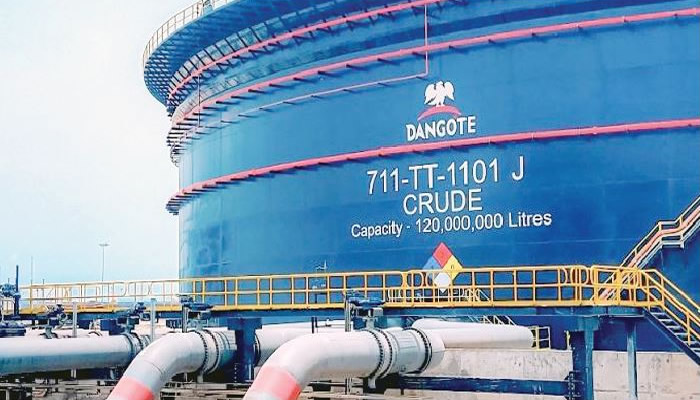
The Dangote Refinery, commissioned in 2024, has rapidly emerged as a game-changer for Nigeria’s energy landscape. With an enormous refining capacity of 650,000 barrels per day, the facility is now able to meet most of the country’s fuel demand, drastically cutting reliance on imports. This achievement has been hailed as a milestone for Nigeria’s energy security and foreign exchange savings, as the country historically spent billions of dollars annually importing refined products.
In support of local production, the Federal Government recently introduced a 15% import duty on petrol and diesel, a policy aimed at discouraging foreign fuel imports and protecting domestic refiners. The combination of this tariff and Dangote’s growing market share has made fuel importation increasingly unprofitable for trading firms like Oando.
While some investors have expressed concern over the short-term financial impact—Oando’s stock reportedly dropped following the announcement—analysts argue that the shift could lead to long-term sustainability and market stability. By rechanneling its operations into crude exports, LNG trading, and metals, Oando is positioning itself to thrive in a diversified energy future rather than depending solely on petrol imports.
Looking ahead, Oando said its focus will be on strengthening its crude trading capabilities, deepening operational resilience, and expanding its footprint in gas and metals. The company’s management believes this strategy aligns with its broader vision of building a “balanced, future-ready energy portfolio” capable of delivering sustainable value in a changing global market.
“The focus going forward is on deepening operational resilience and optimizing existing crude trade flows, supported by the development of offtake-linked financing structures to unlock incremental volumes and strengthen margins,” Oando emphasized.
As Nigeria’s energy sector undergoes one of its most significant transformations in decades, the ripple effects of the Dangote Refinery’s dominance continue to reshape corporate strategies, trade flows, and investment priorities. For Oando, this marks not a retreat, but a strategic evolution—one that reflects the dawn of a new era in which Nigeria refines, consumes, and exports its own energy resources on its own terms.




Responses